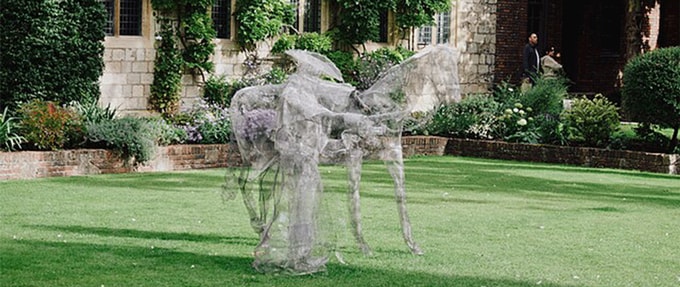

In 1953, a plumbing contractor named Harry Martindale was working in a cellar in York when he heard the sound first.
It was not the usual creak of beams or distant traffic. It was rhythmic. Measured. Metallic. Then, from the wall opposite him, figures began to
emerge.
They were Roman soldiers.
At least, that was how Martindale later described them. Helmeted men marching in formation, their torsos visible above the floor level, as though the lower half of their bodies had sunk beneath it. They passed silently through the cellar and disappeared into the opposite wall.
The account became one of Britain’s most famous hauntings. It is still retold today. But it was not unique.
Across Britain, reports of Roman apparitions surface again and again. York. Mersea Island. Hadrian’s Wall. Colchester. London. Almost anywhere the
legions once stood, someone eventually claims to have seen them again.
The real question is not whether Roman ghosts exist. It is why they continue to appear at all.
The York Cellar Soldiers
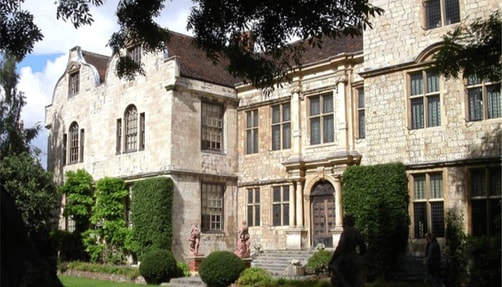
Martindale’s sighting took place beneath the Treasurer’s House in York, once Eboracum, one of Roman Britain’s principal military and administrative
centres.
What gives the story its durability is not simply the figures themselves but the detail. Martindale described round shields and short swords. He recalled helmets that did not resemble the theatrical Roman image most people would recognise from cinema. Later discussion suggested that the type he
described was not widely familiar outside specialist circles at the time.
There was also the matter of height. The soldiers’ legs appeared cut off at knee level. Years later, archaeological investigation confirmed that the Roman road outside once lay several feet below the modern floor surface.
To some, that detail is persuasive. To others, it suggests later reconstruction or unconscious filling-in. Either way, the story has changed very little over time.
And it is far from alone.
Mersea Island and the Marching Figures
On Mersea Island in Essex, near the site of a Roman fort at West Mersea, there have long been reports of figures seen moving along the shoreline in poor light. They are described as groups rather than solitary forms. Ordered. Silent. Intent.
The island once guarded approaches along the eastern coast. Archaeological remains confirm a substantial Roman presence there, part of the late defensive network that watched the sea.
Accounts from Mersea follow a familiar outline. Figures appear briefly, often in mist or fading daylight. No speech. No interaction. Then they are gone.
The repetition is striking. It mirrors York more closely than coincidence alone might suggest.
Hadrian’s Wall: Edge of Empire
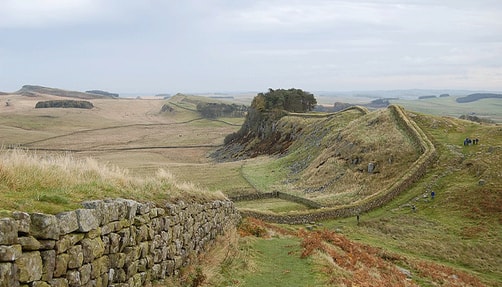
Along Hadrian’s Wall the tone of sightings shifts slightly. Here the reports are sometimes of solitary figures. A sentry shape against stone. A mounted outline crossing open ground. A presence glimpsed between the remains of a fort.
The Wall still cuts across the landscape in a way that few Roman structures do. It is visible, continuous, and undeniably physical. Walking there does not require imagination to understand the scale of what once stood.
Witnesses often describe a sensation before they describe a figure. A quiet heaviness. A sense of being observed. Then a glimpse. Armour where no armour should be. A movement that does not quite belong to the present.
Perhaps it is easier for the mind to supply imagery when the setting already carries such weight. The structure survives. The narrative attaches itself to
what can still be seen.
Colchester: Camulodunum Beneath the Streets
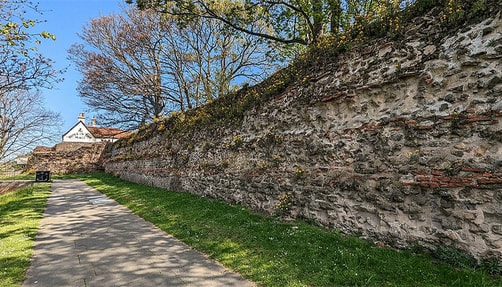
Colchester, ancient Camulodunum, was the first Roman capital of Britain and later the scene of violent destruction during the revolt of Boudica in AD 60 or 61. It was burned. Rebuilt. Fortified.
Over the years, reports have surfaced of Roman figures seen near the Balkerne Gate and beneath parts of the modern town centre, sometimes during building or excavation work. As elsewhere, they are most often described as soldiers. Marching. Standing. Watching. Rarely engaging.
Colchester’s Roman walls still stand in sections. The Balkerne Gate remains the largest surviving Roman gateway in Britain. The past is not hidden there. It forms part of the daily landscape.
When sightings are reported during ground disturbance, it adds a certain symbolism. Layers are opened. Foundations exposed. The old town reappears in fragments. Whether coincidence or interpretation, the pattern is familiar. Military presence. Brief manifestation. Silence.
Why Romans?
Britain’s history is crowded with conflict. Saxons, Vikings, Normans, civil wars, industrial unrest, world wars. Yet Roman ghosts appear with unusual
consistency.
One reason may be visual clarity. Rome is immediately recognisable. Helmets. Shields. Straight roads. Formation. A medieval villager in rough wool does not imprint itself on the imagination in quite the same way.
There is also the matter of infrastructure. Roman Britain reshaped the land in enduring ways. Roads still follow Roman lines. Town centres sit atop Roman
foundations. Walls and bathhouses survive in stone. Physical traces make mental reconstruction easier.
Then there is documentation. The Romans recorded themselves. Inscriptions. Tablets. Carved stones. A culture that leaves written evidence tends to linger more vividly in collective memory. It feels concrete rather than speculative.
Roman Britain occupies a threshold position. Not prehistoric, yet distant enough to feel removed from modern identity. It marks both occupation and
origin. Empire imposed and foundations laid. Threshold periods invite stories.
The Pattern of Repetition
What unites many Roman ghost reports is uniformity.
They rarely speak. They rarely acknowledge witnesses. They often appear in groups. They seem unaware of the present environment.
The impression is less of interaction and more of recurrence. As though
something is being replayed rather than performed.
Some interpret this as residual energy, an imprint of intense activity left behind. Others point to expectation. Roman sites are well signposted, well interpreted, and culturally familiar. Visitors arrive with imagery already formed by education, film, and museum display.
In low light, in quiet spaces, the mind may reach for the strongest available historical template.
Rome provides one of the strongest.
Refusing to Fade
The legions withdrew in the early fifth century. Administrative control collapsed. Britain entered a period of fragmentation and change.
Yet in ghost reports, Rome remains organised. Disciplined. Marching.
Whether these apparitions are psychological constructs, cultural echoes, or something more elusive, they reflect how Britain remembers its past. The Roman period sits heavily in the imagination. It represents order, engineering, and permanence. It also represents disruption and conquest.
In York cellars, on Essex shorelines, along the stones of Hadrian’s Wall, and beneath the streets of Colchester, the legions continue to move in story if
nowhere else.
Not dramatically.
Not aggressively.
But steadily.
And that steadiness may be the most persistent haunting of all.
References and Further Reading
• Otto, Bill. Ghosts of York: A Practical Guide. York Publishing Services.
• Wilson, Colin. Poltergeist! A Study in Destructive Haunting. Pan Books,
1981.
• Devereux, Paul. Haunted Land: Investigations into Ancient Mysteries and
Modern Day Phenomena. Piatkus, 2001.
• Toynbee, J.M.C. Roman Britain. Thames & Hudson.
• Millett, Martin. The Romanization of Britain: An Essay in Archaeological
Interpretation. Cambridge University Press.
• Breeze, David J. Hadrian’s Wall. English Heritage / Batsford.
• Historic England. Roman Britain research reports and regional
archaeological resources.
Featured image via Wikimedia.


