
What is a cursed object?
Here’s what J. W. Ocker has to say on the subject in the introduction to his book, Cursed Objects: “In lore, it’s an inanimate item that brings misfortune, harm, or death to its owners or those with whom it comes in contact.”
There are a couple of key notes in there.
A cursed object needs to be inanimate—if you or I were cursed, we wouldn’t qualify —and it needs to not just be spooky, but to specifically bring bad luck or harm.
Beyond that, however, cursed items take all sorts of forms and get cursed in all sorts of ways. See just how much they vary as we explore the mysteries of these six famous cursed items from all over the world.
Annabelle
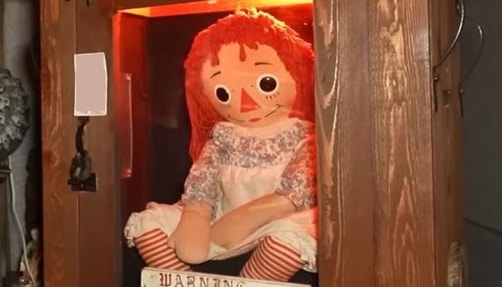
 Photo Credit: Wikimedia Commons
Perhaps the most famous cursed object in the world today, it may be more accurately labeled possessed than cursed. Although, many of the people who came into contact with the doll named Annabelle certainly would say that she brought harm into their lives.
Immortalized in the blockbuster series of Conjuring films beginning in 2013, the real Annabelle doll doesn’t look like the one in the movies. Instead, she’s a Raggedy Ann doll, one of thousands that were popular through the 1970s.
According to self-professed demonologists and paranormal investigators Ed and Lorraine Warren, however, this particular doll is possessed by a demonic entity rather than strictly cursed.
As such, it resided in a place of pride in the Occult Museum in their home in Monroe, Connecticut in a glass case labeled “Warning, Positively Do No Open.”
The Hope Diamond
 Photo Credit: Wikimedia Commons
Perhaps less renowned today than Annabelle up there, the Hope Diamond is nevertheless one of the most famous cursed items in history. It has its own cinematic legacy, having been the partial inspiration for the Heart of the Ocean gem in James Cameron’s landmark film Titanic.
Today, it rests in a secured case in the Smithsonian, but this unique blue diamond had a lively history to get there.
While it wasn’t actually on board the Titanic, it has been blamed for everything from the death of Marie Antoinette to various misfortunes which befell the family of mining heiress Evalyn Walsh McLean, who owned the diamond in the early part of the 20th century.
In fact, it was around the time that legendary jeweler Pierre Cartier sold the diamond to the McLeans that it gained its current cursed reputation, which some believe to have simply been an invention on the part of Cartier to make the gem seem more exotic.
The Tomb of Tutankhamun
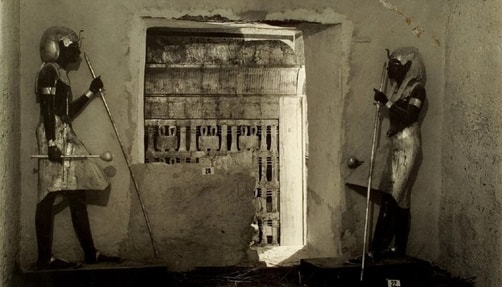 Photo Credit: Wikimedia Commons
If you’ve ever watched a mummy movie, know that you probably wouldn’t have done so if not for the 1922 rediscovery of the tomb of Tutankhamun, a young pharaoh of Egypt’s Eighteenth Dynasty, who ruled late in the 14th century BCE.
The tomb was one of the most perfectly preserved ever found, and it kicked off a renewed interest in Egypt and Egyptology. It also started rumors of a curse, especially after the expedition’s founder died of blood poisoning a few months after entering the tomb.
Despite widespread belief in the curse which formed at least the thematic basis for most mummy movies, only about eight of the 58 people who entered the tomb died within a dozen years. Most lived long, full lives devoid of any inordinate misfortune.
The Crying Boy
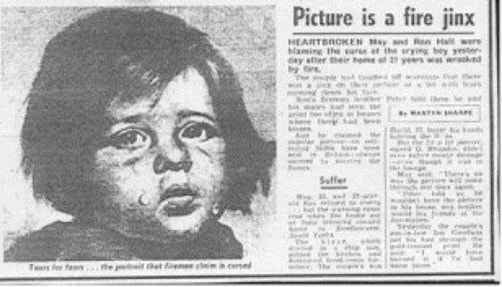 Photo Credit: Alchetron
While many of us might be skeptical of curses, it may be even more difficult to believe that it was once popular to hang mass-produced prints of paintings of crying children in your home. But such was the case prior to 1985, when British tabloid The Sun published a headline, “Blazing Curse of the Crying Boy Picture!”
It seemed that a house in South Yorkshire had burned down, and the only thing left in the wreckage was an undamaged print of one of these ubiquitous paintings. That alone wouldn’t have been enough to spark a curse, however.
For that, The Sun quoted a firefighter who claimed that such pictures were often found undamaged after blazes. The story caught on like, well, wildfire, and before long there was a whole (probably fanciful) backstory behind the paintings, their subjects, and their artists.
Not one to let an opportunity go by, The Sun showed its public-spiritedness by urging readers to send in their own prints of these dangerous paintings, which the tabloid burned in a massive bonfire near the Thames, “dissolving the curse into smoke.”
The Black Angel
 Photo Credit: Wikimedia Commons
In an otherwise nondescript cemetery in Iowa City, there is an eight-foot-tall denizen out of a nightmare.
At one time, this massive angel statue was shining bronze, sculpted by a Czech artisan from Chicago named Mario Korbel. It was intended to stand watch over the graves of the family of Teresa Feldvert, who commissioned it.
And it still does.
Since its installation, however, the angel did something that bronze statues unfortunately tend to do over time: it turned black. And as it did, tales of its deadly curse began to spread.
According to some legends, anyone who touches the statue will die. In others, even so much as letting its shadow pass over you is enough to bring you grave misfortune.
Despite these sinister stories, however, the angel still stands where it always did, in Oakland Cemetery in Iowa City, where anyone who wants to risk being cursed can go see it anytime the cemetery is open.
Polybius
 Photo Credit: Wikimedia Commons
If you believe the stories, Polybius was a video game that appeared in arcades in Portland, Oregon in 1981. The game was so addictive that players couldn’t help returning to it time and again, even while it gave those who played it seizures, night terrors, and amnesia—and eventually killed them.
Fortunately, Polybius appears to be nothing more than an urban legend. But that doesn’t mean there isn’t a real-life cursed arcade game out there.
Enter Berzerk, a 1980 maze shooter that was one of the first games to incorporate speech synthesis so that its killer robots could shout things like, “Intruder alert!” (The game’s distinctive phrases are referenced in the Simpsons episode “Homer Goes to College.”)
Unlike Polybius, however, not all instances of Berzerk were cursed, just one particular cabinet, which stood in Friar Tuck’s Game Room in Calumet City, Illinois.
At least two people passed away near this cabinet. 18-year-old Peter Burkowski died of a heart attack shortly after playing Berzerk in 1982, while Edward Clark Jr. was stabbed in a fight at the arcade in 1988.


