There is perhaps no fandom as delusional as the Hive—I say that as a member. Yellowjackets theories run deep, with many a Reddit thread dissecting everything from the mysterious symbol’s meaning to copper poisoning. There’s even a “delusional theory.”
Like fans of Lost or Severance, some viewers scrutinize every detail, even treating continuity errors as deliberate clues and tapping a little too far into their inner “Citizen Detective.” However, showrunners Ashley Lyle and Bart Nickerson often blur the line between psychological and supernatural horror, so it can be difficult to know what is puzzle-solving and what is pure speculation.
That said, I think the show has some of the most complex, interesting, and morally grey women on television right now—there’s a lot to work with in the threads.
From Shauna embracing her butcher; to Natalie battling her self-destructive tendencies; Taissa with her severe psychological split; Lottie, the manipulative spiritual leader; Misty’s unhinged need for validation; and Van, who uses nostalgia to protect herself.
By allowing the two timelines to coexist—present and past tense—we watch as these women grapple with what happened to them in the wilderness, and how it never truly leaves them. With the fourth and final season set to premiere on November 20th on Paramount+, there’s plenty of excitement to see how the rescue actually unfolds.
As the adult survivors turn on each other, who will be caught in the crossfire, and what other secrets will come to light (and boy do we know they have them!)?
Fans have a lot of thoughts and potential answers for how the last season of Yellowjackets will play out: here are some of the most popular fan theories.
It goes without saying that there will be spoilers ahead, so read at your own risk!
To Supernatural or Not to Supernatural
Starting off with perhaps the biggest point of contention across the fanbase: is Yellowjackets supernatural or psychological?
I’ve dabbled with both views, and it absolutely changes your viewing experience. Is the sleepwalking, hallucinations, and cult rituals emblematic of some more powerful entity in “The Wilderness,” or can it all be chalked up to the girls’ extreme PTSD and shared folie à deux?
The survivors, in both the teenage and adult timelines, often actually argue about this very idea. Teenage Lottie adopts a mantra, “We hear the Wilderness, and It hears us.”
Even when, at the end of season two, the group is participating in a ritual sacrifice, Van asks why Lottie doesn’t just volunteer to drink the poisoned wine herself; Lottie replies: “You know that’s not how this works. We don’t get to decide. It chooses.”
Alternatively, in the adult timeline, Shauna argues, “There was no it, it was just us.” And, I think, for once, I actually have to agree with Shauna on this one—no matter what is happening, supernatural or otherwise, the Yellowjackets have made decisions assuming one thing over the other.
Now, they must reckon with the consequences of their real choices when returning to society. They lived in nature without order and imposed their own twisted idea of governance on it—at the end of the day, how they got there doesn’t matter; only what they were capable of doing does.
Like Mother Like Daughter
An endgame theory, that much of the fanbase has gotten on board with, is that Callie will eventually kill her mother, Shauna. A recurring thematic element in the show is the inescapable loop of violence—as seen in how the past and present often converge in devastating ways.
It becomes clear that Callie is a child of the wilderness; the potential for violence exists within her, and she knows she’s capable of it—as seen when she intentionally shoves Lottie down the stairs at the end of season three. The episode is also, very intentionally, called “Full Circle.”
Shauna is an incredibly flawed person—and is often the engineer of her own suffering. From cheating with her best friend’s boyfriend, Jeff, and then later on him after he becomes her husband, to acting as the butcher and bully of the group—she’s the “Antler Queen,” after all.
Yet she often shifts blame, looking for others to take accountability, so it’d be interesting if this twisted justice came from within: her own child. I think the only person close to the same level of crazy as Shauna is her own daughter—who uses her “accidental” murder of Lottie to drive a wedge between her parents.

Callie (Sarah Desjardins) at the top of the stairs after pushing Lottie (Simone Kessell).
Photo Credit: ParamountThe last thing Lottie says before Callie pushes her down the stairs is that she sees “It” in her and that she is a “child of that place.”
The actress who plays Callie, Sarah Desjardins, said in an interview with The Hollywood Reporter that, when trying to understand her darker tendencies, “Callie has a line where she’s like, ‘So what? It’s adrenaline?’ It’s very defensive. I think she’s desperately looking for ways to explain it away as something else.
But if there’s anything we’ve learned over the course of Yellowjackets, you cannot outrun your fate—especially where “The Wilderness” is involved. A question that I’m left with is: if Callie kills her mother, is she breaking the cycle of trauma or continuing it?
Walter Has Ulterior Motives
There are many theories just about Walter Tattersall’s (Elijah Wood) role in the show: he’s Misty’s Moriarty, manufacturing mysteries for Misty to solve; he’s a serial killer, finding kinship with Misty; but perhaps the wildest, that was, in fact, disproven in season three, is that he is Melissa.
Some fans were convinced Melissa (known as Melissa Hat in the fandom, as her character is always wearing a hat) is a transgender man who is now Walter Tattersall.
Don’t get me wrong, I do understand why this one caught on: Walter has been around for two seasons, and yet, we still don’t know what his larger purpose is in the show.
Now that we learned Melissa (Hillary Swank) is alive and faked her suicide, with other survivors even attending her funeral, some believe she is instead related to Walter. The theory suggests they are siblings secretly working together to retaliate against the Yellowjackets for what Melissa endured in the wilderness.
Either way, there is more to Walter than meets the eye—as shown in his ability to poison and murder Detective Kevyn Tan in the season 2 finale, with zero remorse. At one point, Misty even assumes Walter is a Yellowjacket fanatic when he gives her a case of musical soundtrack cassette tapes, her favorite, and assumes he’s researched her and what happened.
With his motives still unclear, we’re not sure this “citizen detective” has as good intentions as he presents—only time will tell.
Travnat’s Secret Daughter
I think this theory is the clearest example of some fans wanting to fit every character into the larger Yellowjackets universe, using them to answer unanswered questions. Some believe that Lisa (Nicole Maines), who is a member of Lottie’s intentional community, is actually the biological daughter of Natalie and Travis.
Lisa and Natalie first meet in Season 2, when Lottie sends Lisa and a group of her followers to stop Natalie from committing suicide. They burst into her hotel room and whisk her away to Lottie’s compound, where Lisa is in charge of delivering Natalie meals.
At one point, Natalie stabs Lisa with a fork, but Lisa forgives her, and they form a bond over their mutual struggles.
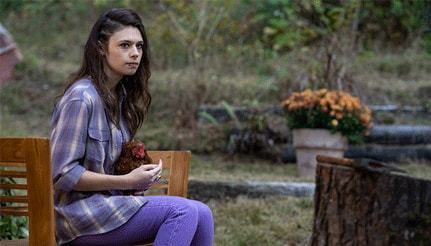
Nicole Maines as Lisa.
Photo Credit: ParamountUltimately, Natalie dies protecting Lisa, jumping in front of her when Misty attempts to inject her with a fatal dose.
In season three, Lottie gives Lisa 50,000 in cash in an envelope, simply reading “I’m sorry,” as Lisa has now left the community, and tells Misty it was, in fact, a cult—though some fans view this as having ties to Travis’ crash payout funds.
The strongest evidence against this theory is that we meet Lisa’s mother—one reason she left to join Lottie’s camp was that she was overbearing. Sure, she may look like Natalie and have a similar demeanor, but nothing suggests Natalie was ever pregnant—or that Lisa is adopted.
Therefore, I’ll be striking this one down as straight-up delulu.
The Pomegranate Theory
On the other hand, I love the pomegranate theory as a recurring, plot-tracking idea—and it has a lot of evidence to back it up.
In Greek mythology, Hades, god of the Underworld, falls in love with Persephone and takes her to his realm. When Zeus, Persephone’s father, intervenes and orders Hades to release her, he tricks Persephone into eating pomegranate seeds. By ancient law, anyone who consumes the food of the dead is forever tied to the underworld.
So, applying that to Yellowjackets, the theory goes that when the girls are in a dream state or having a near-death hallucination, if they accept food or drink during one of these metaphysical moments, they will die—forever sentenced to the Underworld, mirroring Persephone’s fate.
I couldn’t find the direct source of this theory, which I think is genius, as it seems like more of a collective Yellowjackets Reddit effort.
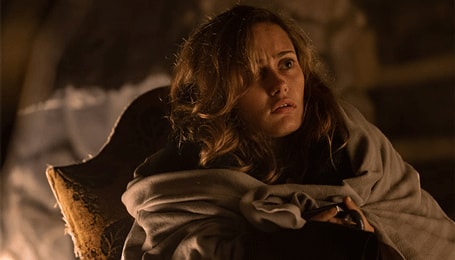
Jackie (Ella Purnell) hallucinating before her death.
Photo Credit: ParamountSome examples that are cited include Jackie drinking hot chocolate while freezing to death; Shauna hallucinating while feeding her baby, who, in accepting the offering, dies; and, on the other hand, Lottie hunting, and on the verge of freezing, imagines she’s in a mall, eating Chinese food, but before she does, Laura Lee stops her, and so she lives.
As the thread expands, there are a lot more ties to Greek mythology, with NoTouch5936 elaborating that before each person accepts the sustenance, they are often lured by a false comfort—like the deceptive nature of the Underworld. Laura Lee’s flight parallels Icarus; the feast scene, where Dionysus, the god of wine, is at the table, and the girls are the Maenads, his violent and cannibalistic female followers.
Keep an eye out for the theory this season…
Metal Poisoning
The metal poisoning theory has been around since season one and is honestly one of the most grounded. With almost 3k upvotes on Reddit, fans agree. While looking for a way out of the wilderness, in season one, episode eight, some of the girls come across a natural stream with a deep, almost unnatural red color.
Although Lottie convinces some of the other survivors that it’s a premonition from the wilderness that “it didn’t want them to leave,” the fan theory suggests the red color comes from oxidized iron, copper, and cinnabar from an illegal mining operation in the area.
The latter, cinnabar, when refined, makes toxic mercury runoff—and if you know anything about mercury poisoning, you may see where this theory is going.
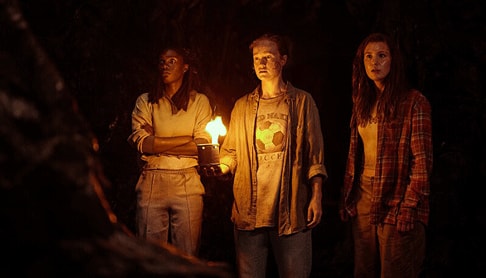
Akilah (Nia Sondaya), Van (Liv Hewson), and Shauna (Sophie Nélisse) hallucinating in a cave.
Photo Credit: ParamountOtherwise known as “mad hatter syndrome,” common symptoms of the illness include hallucinations, depression, mood swings, and more. Many of the girls see someone or something that isn’t there throughout the show—Shauna with Jackie, and Taissa with the Man with No Eyes, for example.
When the survivors eat Jackie’s corpse, the scene cuts between a glorious banquet and the horrifying reality that they’re eating their friend. It seems that the mercury poisoning could be fueling the former delusion.
Overall, I think this is the most rational, evidence-supported theory. It’s clean, but for me, as a viewer, less exciting, if I’m honest.
The Symbol
With the metal poisoning theory in mind, many consider it an explanation for the symbol carved on trees, etched into the attic floor of the cabin, and drawn on the baby blanket Lottie gives Shauna.
Also, during Taissa’s blackouts, when she becomes other Tai, visions from the No-Eyed Man guide her through the woods to trees with the symbol carved out. Later, when Van maps out them all out, they become one giant, overarching version of the symbol.
The symbol, according to theories, represents an upside-down human corpse, hanging from a hook—which definitely mirrors how the girls butcher one another. It also resurfaces in the present, when Misty, Natalie, and Taissa receive a postcard with the symbol, and it appears at the site of Travis’ apparent suicide.
At Lottie’s “intentional community,” in other words, cult, many of the members wear pendants featuring the symbol. There are several other instances—and yet, we’re still not completely sure what it means. Some fans believe it makes a map, or that it serves as some kind of “hobo code.”
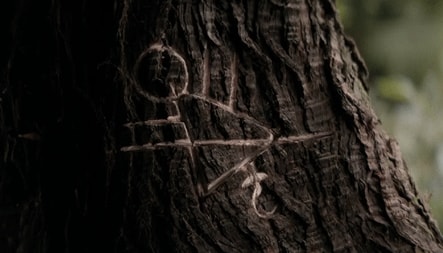
The recurring symbol etched into a tree.
Photo Credit: ParamountThere is, as many fans know, a standalone bonus episode that exists, reported to be centered on the original owner of the cabin the girls live in—dubbed “Cabin Guy” or “Cabin Daddy”—until it’s burnt down at the end of season two.
Yellowjackets star Melanie Lynskey, who plays adult Shauna, confirmed her husband, Jason Ritter, filmed what she called the “lost episode, lost to time or whatever.”
There was no confirmation of who Jason Ritter played, but context clues suggest he was the “Cabin Daddy” the girls find dead in the attic. Jackie, during the season one finale, sees what is believed to be him in her death-dream hallucination, and he tells her, “We’ve been waiting for you,” prompting so many questions: what was he doing out there, is he connected to the wilderness in some way, what does he have to do with the symbol? With the 2023 WGA strike, the episode was delayed, and now it’s likely it will never be released.
Kfunggg, who, if you’re in the Yellowjackets community, have probably come across, unpacks the timeline and discourse on her YouTube channel. Coffee and Cults also has another great video diving into what the secret episode was supposed to reveal, if you’re curious.
The ultimate theory is that the final season will finally offer us an explanation, but honestly, it seems more like wishful thinking at this point.
Tunnel People
I can see why people believe the tunnel people theory—but I’m not one of those people. The idea is that there’s a network of underground tunnels or mines (callback to the metal poisoning theory) underneath the wilderness crash site, and that people inhabit them. Meaning the survivors aren’t the first people to live out there.
The theory kickstarted in season 1, when Lottie began having visions of an underground corridor, before we understood her mental illness. Begging the question: are they real, or do they represent her time spent in mental institutions?
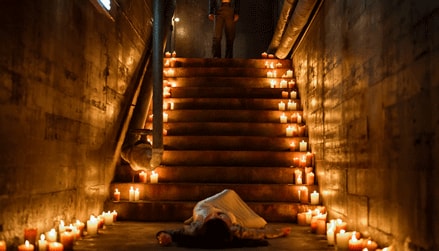
But now that we know what happens to Lottie in season three—the baptism vision tragically mirroring her teenage premonition, lying dead at the bottom of a staircase, surrounded by candles—I don’t believe this supports the theory.
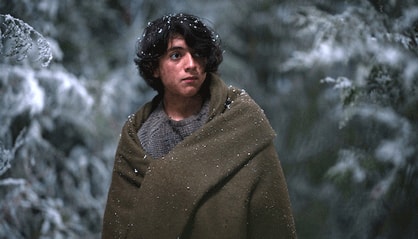
Javi (Luciano Leroux) after he's found.
Photo Credit: ParamountIn season two, it picks up again with Javi, who manages to survive months alone in the wilderness. Travis and Natalie searched for him extensively, yet they couldn’t find him, further suggesting that, perhaps, he was living underground.
When Javi returns, at first, he’s scarred and mute and tells only Coach Ben that “she,” a “friend” who kept him company in the wilderness, told him not to go back to the cabin—which foreshadows his death and sacrifice later in the season. And Coach Ben does actually find the cave Javi inhabited, marked by the symbol, with a defunct fire pit and small animal bones inside.
Though other tunnels do come up throughout the show, notably in season three, Shauna, Van, and Akilah explore tunnels and hallucinate via poisonous gas, the extent to which they connect and tell a larger story is unknown. As for Javi’s “friend,” and her larger connection to the tunnel people, some believe he saw Taissa’s alter ego or even a hallucinated version of the “Antler Queen.”
It’s said that the bonus episode was supposed to actually answer this question, and maybe even put the tunnel people theory to rest, but in the words of Lynskey, it’s been “lost to time or whatever.”
Misty as the Final Girl
Last but not least, I’ve seen this theory of Misty as the final girl popping up a lot, and I’m here for it. It makes sense—she has always been an outsider. She’s not even on the Yellowjackets team; she’s the equipment manager, working on the sidelines.
Misty is also the reason the girls are stranded in the wilderness. Shortly after they crash in season one, she finds the plane’s black box and destroys its wiring. Finally, she’s made to feel essential and valued—the girls need her medical expertise and survival skills to survive. Why would she give that up?
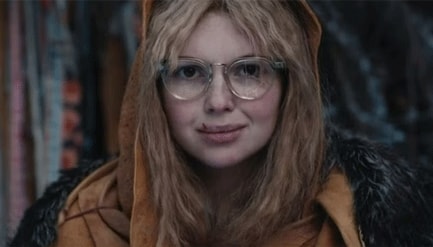
Misty (Sammi Hanratty)
Photo Credit: ParamountUsually, across cinema, the final girl is heroic: think Disney Prescott’s fierce realism in Scream or Laurie Strode’s archetypal babysitter-turned-hardened survivor in Halloween.
For Misty to be the last one standing would be a dark subversion of that trope—the girl who tried so desperately to be a part of the crowd can’t even be in on death. Not to mention, her ability to tackle any situation—whether poisoning others, covering up a murder, or amputating a leg with only basic Red Cross training—shows that she has a unique ability to adapt and outlast everyone.
The idea of “a final girl” is also debated. But there are only four confirmed survivors left, and at each other’s throats. Trust in Shauna has completely collapsed, and Tai and Misty are already plotting against her.
“The Wilderness” needs to be fed, and the card game will only end when there is no one left to draw.
Featured image: Still from Paramount


