When Wes Craven passed away back in 2015, The Guardian wrote that “Wes Craven reinvented horror three times: cinema looks less scary without him.”
The first of those three times was in his directorial debut, Last House on the Left, a grim and gritty grindhouse film that, once more in The Guardian’s words, “decisively removed everything that could have been mistaken as a genre signifier. The finished product had no monsters, no ghosts, no schlocky mention of blood in the title; just an endless parade of nightmarish real-life violence.”
The second was obviously A Nightmare on Elm Street, which gave the already flourishing slasher genre its most bizarre villain while also changing the rules with a killer who could only reach his targets in their dreams.
Nightmare became “the definitive horror of the 1980s” (Guardian again), ensuring a sea of imitators.
The Start of a New Nightmare
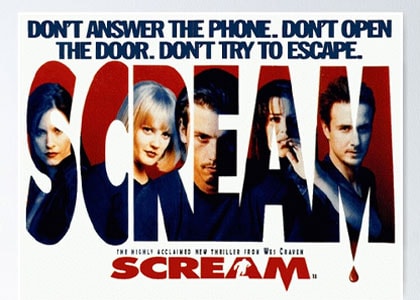

Scream Promotional Poster from 1996.
Photo Credit: RedbubbleThese imitators seemingly troubled Craven somewhat, and, a decade after he had introduced audiences to Freddy Krueger, Craven returned to the franchise with the divisive 1994 entry Wes Craven’s New Nightmare, a metafictional installment in which Robert Englund, Heather Langenkamp, and even Craven himself all play themselves, and the narrative casts a wary eye upon Freddy’s success.
New Nightmare set the tone for the third and final time that Craven would reinvent horror. These days, it needs no introduction, any more than Freddy would have back then. Scream came out in 1996, and horror was never the same. Written by Kevin Williamson, Scream became an immediate hit, making more than ten times its budget, and kicking off a franchise that is still going to this day—one that has raked in more than $1 billion at the box office.
Right out of the gate, the most obvious thing that set Scream apart—and one of the elements that would be most widely, and most poorly, imitated by an army of also-rans—was its self-referential nature.
The characters in Scream didn’t necessarily break the fourth wall to directly engage with the audience, as Deadpool would do in movies two decades later, but they were people who had seen a horror movie before, who were aware of the patterns and tropes of the genre, and applied that knowledge to their own situation.
“There Are Certain Rules That One Must Abide By…”
Among the many memorable moments in Scream are film geek character Randy Meeks rattling off the “rules” of surviving a horror movie—a moment reminiscent of the famous “locked room lecture” in John Dickson Carr’s 1935 murder mystery The Hollow Man, hailed as one of the best mystery novels of all time.
Many imitators of Scream—including some of its own sequels—missed a certain parodic quality in these self-referential elements.
The “rules” in Scream work not because they are true or universal, but because the killer(s) are also film nerds, who happen to be following the same playbook that Randy lays out. It gives the proceedings a quality of fannish one-upmanship, like two people in a comic book shop arguing about whether Superman could outrun the Flash.
There were plenty of other things that helped propel Scream to the position as the defining horror film of the 90s, including the oft-parodied, Psycho inspired cold opening, in which Drew Barrymore is stalked and then gruesomely dispatched by the ghost-faced killer, upending the audience’s ideas about who would survive and who wouldn’t.
Other things also helped make the franchise somewhat unique, though not all of them made it to the screen.
“Not In My Movie…”
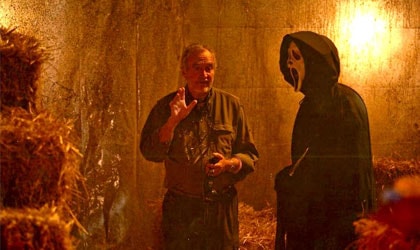
Wes Craven talking with Ghostface on the set of Scream 4.
Photo Credit: FangoriaBetween the time Scream hit cinemas in 1996 and the time Wes Craven passed away nearly two decades later, the original movie received three sequels—and Craven directed all of them. In fact, Scream 4 in 2011 was Craven’s last film before his death.
Even more unusual, for a slasher franchise, is the fact that the sequels to Scream follow not the killer but the victim. Sidney Prescott (Neve Campbell), the original film’s “final girl,” remains the lead character through Scream 4, and she is joined by fellow survivors Dewey Riley (David Arquette) and Gale Weathers (Courtney Cox).
Naturally, of course, you can’t have a slasher franchise without a slasher, so “Ghost Face” is back in every subsequent movie, too. However, instead of resurrecting the same killer, as many of the slashers of the 80s did, these are different people, adopting the look and MO of the original killer for their own assorted reasons.
This admirably reflects Craven’s desire to use the movies to “confront the reality behind the violence they usually found entertaining in slasher films” by focusing even the most outlandish of the franchise installments on the victims, rather than the killer.
“Movies Don’t Create Psychos; Movies Make Psychos More Creative!”
Craven and the main cast weren’t the only folks who returned for most of the Scream series. Kevin Williamson, the original creator, was involved in almost all of them and, even after Wes Craven left us, the franchise barreled on.
Craven and Campbell are absent from Scream 5 and Scream 6, which are helmed by the directing team of Matt Bettinelli-Olpin and Tyler Gillett, while Kevin Williamson himself returned to co-write and direct the seventh film in the series in 2026, also bringing back Neve Campbell.
While Scream 7 made enough money to greenlight a planned eighth installment, it received lackluster reviews, with a 30% at Rotten Tomatoes and a Critics Consensus that reads, “Less a return to Scream's roots than a disappointing creative regression, this seventh entry draws little blood with its dull knife of a script.”
At this point—if not long before now—the Scream sequels may be in danger of doing what they set out to parody, watering down the horror into rote formula that is merely cashing cynical checks written against audience goodwill.
Just as the myriad Nightmare on Elm Street sequels can’t quash the inventiveness of the original, and a million other rape-revenge movies won’t ever diminish the queasy power of Last House on the Left, nothing will take away the movie that we first got 30 years ago, when Scream rewrote the rules of horror films, and proved to be the last time that Wes Craven would help to change the landscape forever.
Feature Image: All Hallows Geek


