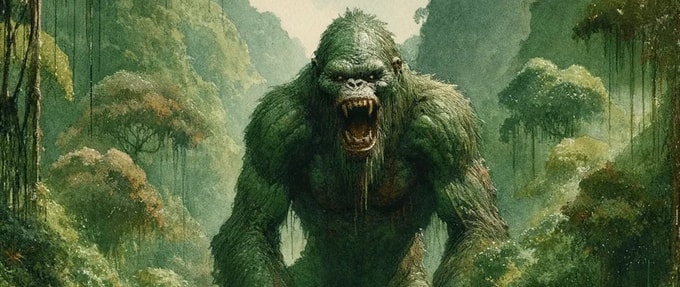

The night had that heavy stillness the Marines came to know well. You could hear almost everything when the jungle settled like that.
Insects kept up their steady noise and the trees held close around the position. It was late, and a handful of men watched the perimeter, listening for anything that might break the usual pattern.
A twig snapping. Brush shifting in a way that suggested someone moving with purpose.
What reached them first felt different. The steps sounded slow and deliberate, heavier than the usual wildlife that passed through.
One Marine later said it reminded him of a person walking calmly in the dark, not an animal darting between trees.
Then came a sharp thud as a stone hit the ground just outside their line. Another followed with a bit more force.
When the men finally caught sight of whatever was out there, they spoke of a shape that seemed broad across the shoulders, covered in reddish hair, and tall enough to rise above the closest leaves before it slipped out of view again.
This creature—a cryptid—would come to be known as a Rock Ape.
Bigfoot’s Influential Shadow Far From Home
Most Americans tend to picture Bigfoot somewhere in the forests of the Pacific Northwest. The idea feels rooted there.
During the Vietnam War, though, troops found themselves in a very different kind of wilderness. The jungles were thicker, louder, and felt alive in a way that could unsettle even experienced men.
As units moved through the central highlands and along the border with Laos, they entered places with their own long history of strange forest tales.
By the 1960s, Bigfoot stories were well known back home. They floated around in newspapers and conversations.
So when soldiers came across something odd in the trees, it was natural for them to reach for familiar language, even if the setting could not have been more different.
The stories never lined up perfectly, but certain details kept turning up.
The creatures were generally described as four to six feet tall, with long arms, a strong build, and hair that ranged from reddish to a dark brown. Many witnesses said they moved upright more often than you would expect from a known animal.
Some Marines remembered hearing sharp calls or a strange kind of laughter that sounded close to human, but not quite right.
Hill 868 produced one of the best known incidents, when Marines reported several figures approaching from the tree line and throwing stones toward their position.
Over time, the nickname “Rock Apes” became part of the everyday language of the war, a quick way of describing something that did not fit neatly into the wildlife troops expected to encounter.
Local Folklore Predating the Rock Apes
Long before any American unit arrived, the region already had a deep tradition of wild man stories. These came from Vietnamese communities, Montagnard groups in the highlands, and families who lived in the more remote mountain areas.
Some spoke about the Người Đá, or Stone People. Others described the Người Rừng, forest dwellers who stayed away from villages, but were sometimes glimpsed at the edge of clearings.
In Laos, there is the Batutut, usually described as a small but powerful forest figure that avoids contact.
What makes these stories interesting is how far back they go. They were part of everyday beliefs about the forest and the spirits that might live within it.
When American soldiers later described their own encounters, some of the traits overlapped with what local people had been saying for generations.
It does not prove anything, but it shows that the idea of upright forest beings was not new to this corner of Southeast Asia.
Natural Explanations Behind Rock Apes
The jungles of Vietnam and Laos hold several primate species, including gibbons and langurs, and these animals can move in ways that look unusual to anyone seeing them for the first time.
Gibbons sometimes rise upright for a moment or two, and their long arms create a shape that can appear oddly human, especially through thick undergrowth.
Vegetation plays tricks with distance, too. Something only three feet tall can look much larger when viewed through layers of shadow and leaves.
Then there were the conditions of the war itself. Troops were often exhausted, moving through ground where visibility changed from one step to the next.
Sound shifted strangely between trees, and anything glimpsed quickly could be remembered in a way that grew larger over time.
Even so, these points do not fully explain every report, and they do not erase the fact that many accounts shared striking similarities.
Despite all the stories told over the years, there has never been clear physical evidence. No confirmed remains, no photographs, and no footprints that could be identified with confidence.
Even so, the reports have lasted because they sit close to the edge of what might be possible.
The forests of the Annamite Range are rich with species that were unknown to science until the late 20th century, including large mammals.
In a place like that, the idea of a shy primate staying out of sight for generations is not entirely unreasonable.
Lingering Tales of the Rock Apes
Sightings did not end when the war did. In the 1970s and 1980s, a number of Vietnamese rangers and scientists claimed to see small upright figures moving through the deep forests.
These later encounters were more often linked to the Batutut, but some of the descriptions overlapped with the wartime reports.
Most of these figures were said to be smaller than the Rock Apes described by Marines, yet the movement and posture sounded strangely similar.
.jpg?w=3840 "vietnam-soldiers_rock-apes")
Rock Ape stories stay alive partly because the war placed people in an environment that could feel overwhelming. The jungle had its own rules and its own presence, and the men who served there spent months trying to interpret every sound and movement.
Under those conditions, stories grow easily. When personal experiences line up with older local beliefs, they become a blend of memory, folklore, and unanswered questions.
The jungle itself plays a part in holding the mystery together. If you stand in those highlands today, the nights still carry many of the same sounds the troops once heard.
The air moves slowly through the canopy and the darkness settles in thick layers between the trunks. Veterans who revisit old positions often talk about how quiet everything feels compared to the noise of the war, yet the forest never seems empty.
A sudden shift in the brush, a call that echoes strangely, or the sense of something moving just out of view can be enough to revive the old stories.
Whether the Rock Apes were misidentified animals, reflections of local tradition, or something that has yet to be understood, they left the conflict with one of its most intriguing legacies.
The forests keep their secrets well, and this is one of the stories that continues to linger there.
Featured image: connectparanormal.net


