
Happy Pride Month! It's the perfect time to talk about one of my favorite topics in the world: queer horror!
But not just any queer horror; instead, we’re going to focus on the queer horror films you might not have seen before (or in a quite a while).
So in honor of Pride Month, here are five queer horror films that you might have forgotten.
The Old Dark House
Director James Whale, who helmed Frankenstein, Bride of Frankenstein, and The Invisible Man, was openly gay in Hollywood at a time when being out was sadly not nearly as common as it is today.
Unfortunately, it did affect his long-term prospects in the industry. But during his heyday in Hollywood, he made four of the very best horror movies of all time.
The least celebrated of those titles, The Old Dark House, is arguably one of the wildest.
A group of people become stranded during a thunderstorm and must take shelter in a foreboding house owned by the Femm family. With a groaning butler played by Boris Karloff and a secret relative hidden upstairs, things only get weirder from there.
This pre-Code classic is such an eccentric little film, and one that absolutely deserves to be celebrated during Pride Month—and every other month, for that matter.
Dracula's Daughter
James Whale’s Universal horror films aren’t the only ones that are queer-coded.
This 1936 sequel to Dracula literally picks up right where we left off in the 1931 classic: with Van Helsing staking the eponymous count. However, the police barge in and promptly arrest him.
In a way, though, this whole opening is a bit of a MacGuffin for our real story: Dracula’s progeny doesn’t want to be a vampire, and is searching for a way out of her torment.
All of this is clearly just a smokescreen for the real themes of the film, which involve queerness and the struggle for self-acceptance.
Gloria Holden is incredible as the reluctant Countess, and co-star Marguerite Churchill turns in a strong performance as Janet, the plucky assistant to a doctor trying to clear Van Helsing’s name.
It’s a daring film for the 1930s, and one that’s absolutely worth a watch.
Nadja
This 1994 black-and-white vampire film clearly takes a page from Dracula’s Daughter, with a Van Helsing character who’s even arrested for murdering someone from Transylvania.
But Nadja is so much more than a simple retreading. It’s a quiet meditation on eternal life, and it’s got a decidedly bleak arthouse vibe that feels like nothing else that was coming out of the film world at that time.
The title character (portrayed by Elina Löwensohn) is wandering through the streets of New York City at night, trying to find her place in the world, all with some seriously gory results.
With David Lynch on board as an executive producer (and in a cameo role as a morgue attendant), this one is a very surreal, very bloody 90s film.
Vampyros Lesbos
Probably best remembered for its exploitation title, Vampyros Lesbos is a bizarre and dreamy film that, yes, also has plenty of nudity to match its name. However, there’s so much more to this film than just its sex scenes.
Starring the incandescent Soledad Miranda, this 1971 erotic horror film follows the gorgeous and vampiric Nadine, who seduces an American lawyer by drawing her toward her remote luxury island.
I mean, really, what’s not to love?
Tragically, Miranda died far too soon in a horrific car crash in Portugal at age 27, but her cinematic presence—in both this film and as Lucy Westenra in Count Dracula starring Christopher Lee—still endures over 50 years later.
The Velvet Vampire
What is it about vampires and queerness that dovetail so well? Without a doubt, vampires have the best queer representation of all the horror subgenres.
And The Velvet Vampire is absolutely up there as one of the best vampire films you’ve probably never seen.
Written and directed by Stephanie Rothman, this 1971 film is among the most sun-drenched vampire films in cinema with its gorgeous desert landscapes. Better yet, keeping with the original lore from Dracula, our titular bloodsucker can absolutely go out in the daylight—while driving her yellow dune buggy, no less.
The mysterious Diane LeFanu invites a young couple to her desert estate, and it’s not until they arrive that they realize she’s planning to seduce them both. But that description doesn’t do this strange and stylish film justice; this is truly one that needs to be seen to be believed.
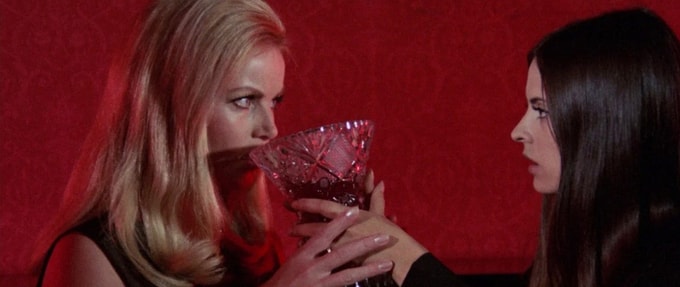
I will holler from the rooftops about this film every chance I get, because it’s that much fun, so be sure to stream it this month and celebrate Pride in bloodsucking style.


