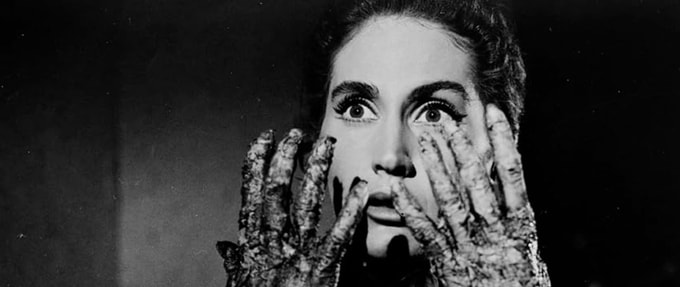

In 1930, working at night, on the same sets that Tod Browning, Bela Lugosi, et al were using during the day, Mexican actors famously made their own Spanish-language version of Dracula. Within a few years, Mexico’s burgeoning film industry was turning out gothic horror pictures of its own.
From sinister monks to Mexico’s most famous phantom, these early Mexican horror films sampled from the country’s own gothic literary traditions, as well as the cinematic techniques that had been pioneered north of the border and elsewhere.
By the 1950s, a sea change was beginning to take place in Mexican genre cinema, helped along by the popularity of masked wrestlers such as El Santo, Blue Demon, Mil Mascaras, and others. Movies starring these luchadores came to dominate Mexican genre cinema, helping to shape a particular type of film found nowhere else. El Santo and friends often fought classic gothic threats, including vampire women, Frankenstein’s monster, and more.
Alongside these films, however, studios such as Alameda and ABSA continued to turn out classic gothic chillers that still had an unmistakably Mexican flavor.
Recently, I partnered with the Mexican Consulate of Kansas City to program a month-long series showcasing some of these movies at the Stray Cat Film Center—and the folks at The Lineup were kind enough to let me talk a bit more about them here.
La Llorona (1933)
It should probably come as no surprise that what is widely considered Mexico’s first homegrown horror film is about its most famous phantom—the legendary “crying woman” who has been the subject of so many movies over the years.
Directed by Ramon Peon, this first cinematic adaptation opens with the sound of spectral wailing, but is often dominated by silent-era approaches to filmmaking.
Considered lost for nearly half a century, a badly abused 16mm print of La Llorona was recently restored, so modern audiences can see where Mexican horror cinema began.
The Phantom of the Monastery (1934)
Restored by the UCLA Film & Television Archive and the Film Foundation, the re-released Phantom of the Monastery was screened at MoMa in New York, and it’s no wonder. Helmed by Fernando de Fuentes, who has been hailed as “the most versatile filmmaker of early sound cinema,” Phantom is a crisp, beautiful film full of strange sights and dark shadows.
It doesn’t hurt that it was shot almost entirely in real locations, including an abandoned Jesuit school and the Museo de El Carmen, where the film shot its memorable scenes of real mummies—mummies that you can still visit in that same museum today, if you happen to be planning a trip to Mexico City.
The Vampire (1957)
Released in 1957, The Vampire changed everything. Producer Abel Salazar – who had a hand in many of the classic horror films of Mexico’s golden age—“knew that the success of Universal Pictures over its competitors was due to the legion of monsters that inhabited its filmography,” and brought that same playbook to Mexican horror.
Essentially a home-grown take on Universal’s Dracula, The Vampire became an international hit, and spawned a couple of sequels, including The Vampire’s Coffin in 1958 and the loosely-connected World of Vampires in 1961.
It’s also notable for being the first major film to show vampires sporting the canine fangs that have become so inextricably associated with these creatures of the night.
Black Pit of Dr. M (1959)
Director Fernando Mendez followed up The Vampire and The Vampire’s Coffin with this Edgar Allan Poe-inflected tale whose Spanish-language title more closely translates to “Mysteries from Beyond the Grave.”
In a classic story of “be careful what you wish for,” two doctors make a pact: the first of them to die will find a way to reveal the secrets of what comes after to the other, setting off a series of chilling and tragic events.
Released in the United States under the misleading title Black Pit of Dr. M, this played on late-night television until the mid-1970s, when it suddenly vanished and was largely unavailable to Anglophone audiences for almost half-a-century before being restored and re-released as part of the Mexico Macabre series from Powerhouse Films.
The Witch’s Mirror (1962)
I ended my Mexican Gothic screening series in the same place I’m going to end this article—with Carlos Enrique Taboada’s 1968 film Even the Wind is Afraid, which “revitalized the genre” by bringing gothic horror into modern-day Mexico, where “supernatural forces from the past continually exist alongside and threaten to invade the present.”
Before his directorial debut, however, Taboada was already an established screenwriter of such gothic chillers, and one of his most celebrated earlier works is this unforgettable feature, which mashes up everything from Rebecca and The Hands of Orlac to Eyes Without a Face, while adding an effective witchy subplot and a wide range of striking practical effects.
The Curse of the Crying Woman (1963)
Mexican horror cinema began with la Llorona, and it has returned to the well of the “crying woman” legend many times since—perhaps never more memorably than in this 1963 spook show produced by and starring Abel Salazar.
It has been called the “filmic testament” of Salazar’s ABSA studio, “the sum total of its technical and artistic achievements,” which you can see in the film’s flashbacks, which use footage from an array of other ABSA releases. If you prefer your Mexican horror with a little more camp, you probably can’t do better than Curse of the Crying Woman, which throws just about every
isual trick, special effect, and gothic trope you can imagine at the screen, including copious nods to Mario Bava’s 1960 classic Black Sunday.
Even the Wind is Afraid (1968)
Screenwriter turned director Carlos Enrique Taboada has been called “the duke of Mexican terror,” and his 1984 film Poison for the Fairies won him two Ariel Awards—Mexico’s equivalent of the Oscars—for Best Picture and Best Director.
Poison for the Fairies was, in many ways, the culmination of a string of gothic pictures Taboada directed, beginning with Even the Wind is Afraid, a tale of ghostly happenings in a girls’ boarding school. Shot in vivid colors and making use of a nearly constant moaning wind, Even the Wind is Afraid has more going for it than merely one of the best titles in horror history—though it obviously has that, too.
It helped bring an end to the golden age of Mexican genre cinema, by pivoting Mexican gothic horror in an exciting new direction that inspired filmmakers such as Guillermo del Toro.
Feature Image: The Block Museum of Art


