
Step into the shadow-drenched world of Laird Barron, where hardboiled noir collides head-on with the cosmic insanity of the Lovecraftian tradition.
Barron isn’t just writing horror; he’s crafting a bruising mythology of existential dread, populated by tough-as-nails protagonists who—despite their grit — are hopelessly outmatched by the ancient, hungry things lurking in the stygian dark over our heads and under our feet.
From the mossy rot of the American West to the vast, uncaring void of the cosmos, Barron’s stories leave a mark that bruises the soul. Whether you’re a devotee of the Old Leech or fresh meat for the grinder, Barron’s fiction demands your attention. If you’re looking for a ripping good yarn that refuses to offer easy answers, you’ve come to the right place.
The award-winning American horror writer has been in and out of the hospital this past year, so we asked the void (or just emailed some brilliant horror authors) about the undisputed heavyweight of modern weird fiction, as told by some of his fellow horror authors, Paul Tremblay, Stephen Graham Jones, Gemma Files, and Victor LaValle.
A special thank you to Laird Barron’s longtime friend in the horror industry, John Langan, for connecting The Lineup with the above authors via email. Langan provided a little update on Barron: “At the moment, Laird’s suffering from a 70% loss of hearing in his one good ear, and diabetes-related impairment to his one good eye. As you can imagine, it’s been a lot for him, and it’s really cut down on his ability to do these kinds of interviews.”
Barron is safe at home and recovering, but needs more time before future interviews, which was later echoed by his management team at New Leaf Literary & Media via email. The Lineup editorial team wishes Laird all the best in 2026, and we hope to speak with him in the near future.
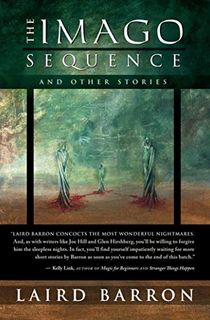
The Imago Sequence and Other Stories
The Imago Sequence and Other Stories was my first introduction to the cosmic horror world from the mind of Laird Barron. His short stories hit like an ax cracking through an ice sheet.
Barron's debut collection of nine cosmic horror and dark fantasy short stories is known for its sinister comingling of Lovecraftian and two-fisted noir themes. Barron still loves to feature middle-aged male protagonists confronting a cavalier, unsettling universe, watching from the shadows.
This Gordian Knot of horror stories understandably won the Shirley Jackson Award for Best Collection in 2007 and includes acclaimed tales like the title story, "The Imago Sequence," and "Probiscus.”
Fellow horror author Gemma Files, whose novel Experimental Film (2015) garnered the Shirley Jackson Award for Best Novel and the Sunburst Award for Best Canadian Speculative Fiction (Novel) in 2016, agrees that Barron is a special writer in the field and a major adult influence.
“Laird Barron is a gentleman and a force of nature, a singular and potent creative voice, someone I consider key in terms of mainstreaming the corner of the horror genre that revolves around cosmic horror. His influence is multifoliate. I've rarely come across anything of his that hasn't fascinated and challenged me.”
As a good entry point, Files posits via email that “Barron gradually redefined the last double decade's increasing reliance on curt word-count as a mark of professionalism. His novellas, novelletes, and short story collections left lovely bruises on her psyche.
“He's brutal and poetic, and his word choices are so wonderfully specific, always integral to effect,” Files says. "Occultation and The Beautiful Thing That Awaits Us All are great places to start, but there's no bad entry-point with Barron.”
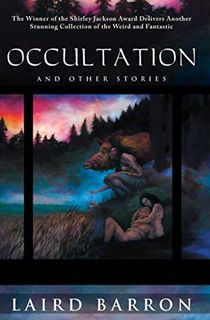
Occultation and Other Stories
Another award-winning collection. Another stunning window into the darkness in our ink-black corner of the universe. This time, the plaudits came to Laird Barron for the 2010 Shirley Jackson Award for Best Collection for Occultation and Other Stories.
Additionally, the collection story "Mysterium Tremendum" won the 2010 Shirley Jackson Award for Best Novella. The stories in Occultation lay a spiderweb in front of modern horror readers for Barron’s Old Leech Mythos, which is greatly expanded upon in later Barron tales and most notably in the 2012 novel The Croning.
American horror author Stephen Graham Jones (Bram Stoker winner for The Only Good Indians, Mapping the Interior, and Night of the Mannequins) thinks Barron is beyond the label of “two-fisted,” firmly ensconced in the world of cigar-chomping adventurers and pulp horror explosiveness.
“I think the real haymakers Laird's always thrown have been against the...I guess I'll call it ‘conception,’ though ‘presumption’ feels more right: what he's undoing, what he's pushing back against, is the conception that this world we live in, it's not actively trying to tear us limb from limb, it's not always trying to digest us, disappear us. A lot of folk go through their day-to-day life assuming that, so long as they don't stray into the dark corners or ring the wrong doorbells, they'll be safe. Read Laird's fiction if you want to put that to the test, though.”
Jones loves that Barron’s work gets “its teeth into your flesh, its shadow into your sleep, its uncertainty into your waking world.” He loves that even if you put the gift down (and Occultation is truly a literary gift), you don’t want to turn your back on it.
Barron writes with a scientist’s eye for details and a campfire storyteller's understanding of mythos far beyond the fragile architectures set to spin by H.P. Lovecraft and Clark Ashton Smith decades before. Barron lives up to his reputation for elegantly crafted and nightmare-inducing tales across these six reprints and three original stories.
One of our favorite quotes from the book is from “The Forest:” "The brain is a camera, and once it sees what it sees, there's no taking it back." How fitting and terrifying.
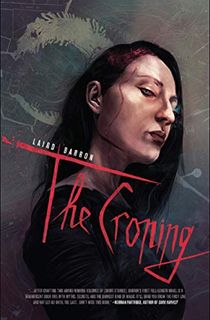
The Croning (2012)
The Croning
The Children of the Old Leech cult return in The Croning, a cosmic horror novel about an elderly geologist, Donald Miller. The unlikely protagonist uncovers a sprawling cult over the course of the book, and how his own family is involved with its complex and insidious mythology.
Multiple Bram Stoker winner and Shirley Jackson Awards juror Paul Tremblay (A Head Full of Ghosts, The Cabin at the End of the World, and Survivor Song) is “convinced the rise of horror's popularity over the last decade is in part due to Laird's imprint on the genre.”
He notes that a Laird Barron novel, novella, or short story feels like what we’re all living through in the 21st century. “No other writer as deeply investigates our smallness within the wider maelstrom in quite the same way Laird does,” Tremblay comments via email.
“He's not writing about nihilism, which would be easy to do. Instead, with his mashups of cosmic horror, crime, literary, fantasy, and pulp, he wrings out authentic emotions that cannot be easily verbalized, ones that honor our existence, while at the same time he demonstrates how fleeting it all is. There's awe as well as terror, and a weary comfort in the 'yes, you too' recognition of how fucked we all are.”
The Beautiful Thing That Awaits Us All
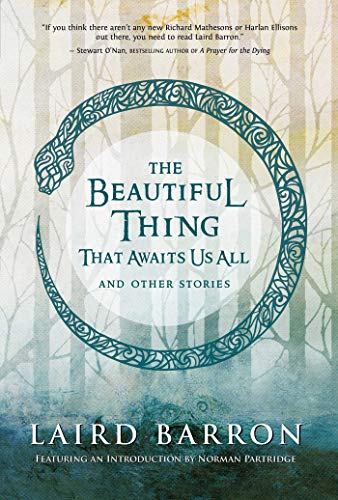
The Beautiful Thing That Awaits Us All is a 2013 collection of horror and dark fantasy short stories, featuring interlinked tales with recurring characters and locations like Ransom Hollow and the Broadsword Hotel, blending noir, supernatural horror, and Lovecraftian themes.
Key stories include "Blackwood's Baby" and the World Fantasy Award-nominated "Hand of Glory," showcasing Barron's signature style of gritty prose and terrifying, unknowable forces. It is another stunner that keeps you guessing with each page and story. This is one of Gemma Files’ favorites from Barron.
“I'm particularly impressed by his investment in just doing whatever the hell he wants, his unabashed, genre-shifting love of pulp adventure, noir, and sword and sorcery. He constantly folds his own interests into whatever he's doing, without holding himself to any sort of ‘oh, my audience won't like this’ account.”
Swift to Chase
Divided into three sections, the stories in Swift to Chase are linked like treasures inside a sliding puzzle. Many of these psychologically damaged stories are set in Alaska or other bleak landscapes and feature recurring characters like Jessica Mace, Julie Vellum, and Steely Jay.
The tales were originally published between 2012 and 2016. It reads like a novel told through short stories, which can make for a destabilizing first read, so this book is better to check out after diving into some of the other short story collections on this list.
His nightmarish sci-fi worlds in this book are particularly important to call out. Also, Barron’s fondness for dogs (like Jessica Mace) shines through here. It’s an empathic element of his storytelling that is often undersung.
Fellow horror author Victor LaValle is the author of a short-story collection, Slapboxing with Jesus, and five novels: The Ecstatic, Big Machine, The Devil in Silver, The Changeling, and Lone Women. His fantasy-horror novella, The Ballad of Black Tom, won the 2016 Shirley Jackson Award for best novella in the same year that Swift to Chase was published. LaValle enjoys leaping with Barron each time.
“Laird Barton’s writing is a kind of cliff I’m always eager to fall from. Whether it’s one of his stories, the novels, the novellas, I’m anticipating the wondrously cosmic horrors to come, but the thing that warms and surprises me every time is Laird’s voice,” LaValle said.
The warmth of that voice is also a key component for LaValle in why Barron is such an infectious read for him each time. “I keep thinking, ‘if he’s not scared, then I don’t have to be.’ And by the time I realize I’m wrong, the evil is already right up close. Gets me every time.”
Blood Standard
Blood Standard is a hardboiled crime novel, the first (and best) in Barron’s ripping Isaiah Coleridge series. The novel follows a former mob enforcer in Alaska investigating the disappearance of a teenage girl in upstate New York and how he gets pulled back into a seedy underworld after an exile.
It's gritty and hard-nosed, but not completely devoid of some good black humor mixed into its mythological and misanthropic plot. The memorable Coleridge protagonist has appeared multiple times and is incredible.
Whereas the following books weave in even more cosmic horror, Blood Standard is more approachable for multiple reading audiences.
In hindsight, the horror elements were hidden in plain view for Blood Standard, but just lurking underneath a solid crime story. Black Mountain (2019) and Worse Angels (2020) finish Barron’s crime thriller trilogy with a bang, and Coleridge makes a fateful return after the pandemic for The Wind Began To Howl: An Isaiah Coleridge Story (2023).
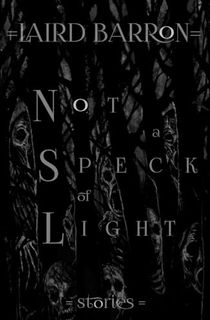
Not a Speck of Light: Stories
Pitch black terror in the middle of a starless night is the terrifying canvas for Barron’s latest short story collection, Not a Speck of Light. It is his fifth short story collection, published in 2024, and features sixteen tales of weird horror fiction. There is cosmic dread, family bruises through the lens of America, and gut-twisting survival.
The book includes stories like "In a Cavern, in a Canyon" and "The Glorification of Custer Poe," and has that inimitable Barron voice stretched into new territories. Paul Tremblay and The Lineup’s favorite story is “Tiptoe” hands down. No contest whatsoever.
“Tiptoe” is about the photographer Randall Vance, who grew up in the 1960s, the youngest of two children in an upper-middle class family. His mysterious father is an engineer for IBM and loves to play a strange game called “tiptoe.”
He sneaks up on his sons and wife and pinches them. Sounds pretty damn innocuous at first blush, but Randall’s dad never loses the game, never gets caught, and his weird game symbolizes his Darwinian philosophy that shines a murky light on a hidden ocean of menace.
Tremblay goes on in detail for The Guardian about his passion for the insidious tale. First appearing in the Shirley Jackson tribute anthology When Things Get Dark, ‘Tiptoe’ works as a smart homage to Jackson, but also sings as a weird tale.
“While there is nothing expressly supernatural in the story and no scenes of explicit violence on the page, I’ve never had a story get under my skin in the way ‘Tiptoe’ does. It picks at one of our oldest, hardwired fears, that of being the unwitting prey to a predator that we are not equipped to avoid.”
Barron got Tremblay’s leg jumping on the second page with “What I do know, is he was the kind of guy nobody saw coming. It’s a chilling tone-setter to a story that becomes more ominous with every page,” Tremblay raves.
“That line and all the unspoken hints and secrets are there, queuing up behind you, somewhere over your shoulder, there to see plainly if you only dare look. And in the last two breathtaking pages, Laird makes you look.”


