
The television adaptation of Anne Rice's The Vampire Chronicles is one of the best horror shows on TV—horror or otherwise. And there are a lot of reasons for that.
For one, the performances from the cast are remarkable, building characters up into three dimensional, nuanced beings. Working in tandem with fantastic writing, of course.
The show blends monstrously dark violence with tender beats, establishing a contrast that mimics the push and pull—recoil in disgust and lean in with desire—of its main characters trapped in their cycle of tormented love.
The first two seasons of the show, Interview with the Vampire, are heavily influenced by changes to time period and character identity. While I'm in no position to speak too in-depth about it, it's plain to see that Louis de Pointe du Lac (Jacob Anderson) is a character whose Black identity not only informs, but elevates his character and choices.
On a very different level, as the narrative of the third season, The Vampire Lestat, shifts to focus on Lestat de Lioncourt's (Sam Reid) point of view, the season is shaped by a very different identity.
Lestat is many things: an unhinged diva, a callous manipulator, a deeply sensitive soul desperate to be loved, a violent monster, an elitist Frenchman.
But it's his identity as a musician that truly shapes the course of this season.
Lestat wasn't always a musician. When he ran off to Paris, he was an accomplished actor, stepping into roles to rake in attention and validation.
It was his lover, Nicki (Joseph Potter), a violinist, that introduced him to a world of music. But even then, Lestat does not take up the craft until after he becomes an immortal creature of the night.
When Lestat becomes Akasha's watcher, he is told that the ancient vampire has a deep fondness for music. But Lestat admits that he doesn't know how to play.
His dark gift allowed him to pick up the craft quickly.
Sifting through the timeline of the entirety of the show, we know that prior to Lestat's run as a rock star ("star" being, perhaps, debatable), he composed two things: the melody of Nicki's music box, and the song he sent to Louis, “Come to Me.”
He, of course, personally takes no credit for any part of “Wolverine Blues,” despite Louis recollection. Memory is a funny thing.
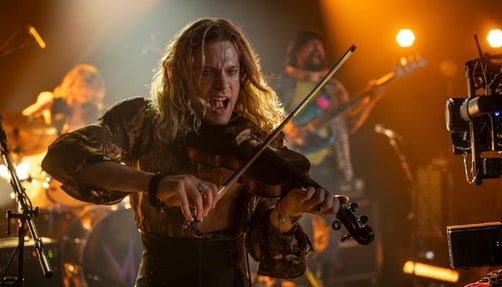
 Photo Credit: AMC
And it is the memory that Lestat's music pays tribute to. Memory, on his own terms.
For Lestat, his songs are a way to reclaim the truth as he sees it—to right the narrative after the biased reframing Louis gave their story in his infamous biography. Beyond the wreckage of so-called lies in Daniel Molloy's (Eric Bogosian) book, Lestat has also spent a lifetime of being woefully misunderstood.
There are, of course, parts of his musical journey that he pushes forward as a means to please his mother, Gabriella (Jennifer Ehle). His public airing of the existence of vampires puts him at the forefront of The Great Conversion, making him both the subject of reverence and ridicule.
Ironically, though his bandmates were turned into vampires to help him create music fit for vampire ears, his music also allows him to be “embraced” by humans.
For Louis, his connection to his humanity—something that runs deeper in him than it does in other vampires—is his community. For Lestat, music is his anchor to humanity.
Still, though it is easy to feel compassion for Lestat through his music, his compositions and lyrics don't absolve him. He doesn't mean them to.
His music merely explains him.
Well, not merely.
Songs like “Long Face” and “Butterscotch Bitch” let us peer into Lestat's sense of self. There's bravado there—as well as a more than healthy dose of vanity and dramatics—but alongside it is vulnerability, self-awareness, and an undercurrent of self-loathing.
“The Loneliness” cracks him wide open, staring into the gaping mouth of immortality, and forcing him to reckon with the things he has lost, destroyed, or both.
With jaw-dropping audacity, “Big Boss” cuts Armand down to size, getting straight to the point of exactly what Lestat thinks about having rules—let alone antiquated, hypocritical ones—foisted upon him.
One of my favorite songs from the season, “Biggest Fan,” is another masterpiece of mockery. It takes the most horrific moment in the whole of Lestat's existence and whittles it down into something nearly pedestrian.
Magnus, Lestat's maker and own personal mental boogeyman, is reduced to nothing more than a desperate obsessive. It strips him of (at least some) of his power, making him look like the fool in the situation.
And the composition of the song itself is so haunting and seductive it speaks to the irresistible pull of vampirism. It speaks to the feeling of resisting until you can't help yourself.
You know you shouldn't want it, but you can't stop it. Then if you have it, well, you might as well enjoy it, right?
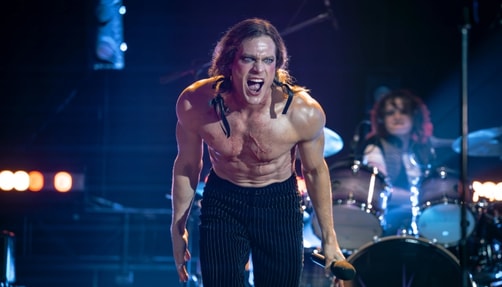 Photo Credit: AMC
Perhaps one of the greatest feats of this season's music is “Stained Glass Eyes.”
Taking up so little space in the story, it works hard to reframe a lot about what we know about the dynamic between Lestat and Claudia (Bailey Bass and Delainey Hayles).
It speaks to a tenderness and near reverence—an actual fatherly connection, and an acknowledgement of a sameness between them. It paints a picture of unthinkable grief and unpalatable guilt.
The song is a nod to Lestat's accountability. Yet while he accepts his role and admits to the pain it causes in him, there's still a certain inevitability in the words that lends to the fact he wouldn't necessarily have done anything different.
There's a “me or you” undertone running through the course of the song, lined with a thread of melancholy respect.
Throughout the season, Lestat is haunted by his muses. They propel him to write these songs, either to gain control of the narratives they're trying to drive or to drive them away.
But the songs are also, in part, a way for him to spend time with these muses. It's a walk down memory lane that feels tangible.
It's an acknowledgement of that insidious loneliness. An acceptance of it, if not a surrendering to.
And in the final, breathtaking episode of the season, in what is leading up to what should be Lestat's final moments, his muses all sit around him in judgement. “Evidence of the soul.”
But perhaps the best evidence of the soul is Lestat's music itself, doused in the throw away cruelty of a sometimes monster, but threaded through with all the pettiness, passions, and pain that are born only from humans.


