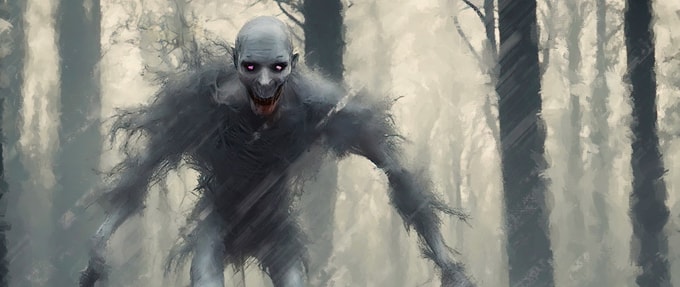
We've seen them in movies, television shows, literature, and video games. Some have even reported seeing them in person—a sighting earlier this year places one such eerie creature in Rock Hill, South Carolina.
But what is a wendigo?
The clearest answers come from Indigenous folklore, which their haunting stories originated from. More specifically, Algonquian folklore is where the bulk of wendigo mythology comes from.
The Algonquin-speaking peoples (including the Cree, the Innu, the Naskapi, the Okibwe, and the Saulteaux) hold the wendigo as a consistent part of their traditional belief system. However, descriptions of the wendigo have slight variations across individual cultures.
Still, in all iterations of the wendigo, the creature is believed to be an evil cannibalistic spirit. Some believe this spirit possesses humans and inflicts them with an insatiable hunger for human flesh.
Uncontrollably driven towards cannibalism, those transformed into wendigos are thought to be indiscriminate killers. They stalk through remote forests and woodlands, tormenting their relentlessly hunted pray before going in for the slaughter.
Some cultures—primarily the Eastern and Westmain Swampy Cree, the Innu, the Naskapi, and the Ojibwe—describe wendigos as humanoid giants, towering far above normal human beings. It's believed in these cultures that a wendigo grows in proportion to the human flesh it consumes, ensuring it can never truly be full.
In these depictions, though the wendigo is inherently gluttonous, the creatures always appear severely gaunt from starvation. They are also described as having large, sharp claws and glowing eyes.
It's said that you will be able to tell if a wendigo is close by, as they carry with them the foul, permeating stench of death.
In some depictions wendigos are thought to have hearts encased in ice—a nod to the fact that famine often follows in winter's footsteps.
Some cultures believe that wendigos can maintain the power of human cognizance and speech, though others believe the creatures are purely animalistic monsters.
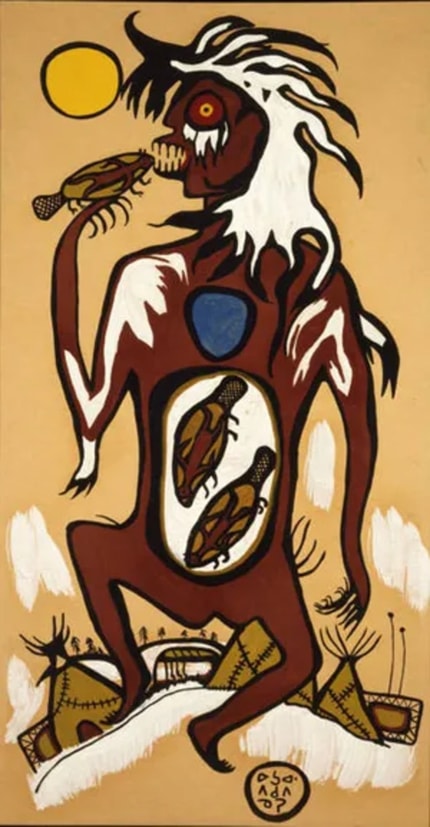
 Photo Credit: britannica.com
Can wendigos change back to human?
There are several traditions that believe that a human can transform into a wendigo when their hearts are consumed by greed. Others assert that the transformation occurs only when a person resorts to consuming human flesh.
Another belief holds that a human can transform if they remain in contact with wendigos for too long.
But can a human who transforms into a wendigo ever be saved? This, too, varies from culture to culture.
Many cultures assert that the only relief for these tortured individuals is the release of death, killing both the monster and the human at its center. Very few cultures believed that killing a wendigo would return the human inside.
There is a local tale amongst the Wabanaki near Bar Harbor, Maine that holds the belief that the wendigo can be redeemed. One legend tells of a woman who rehabilitated the creature's humanity through kindness and compassion—as well as hot bear fat soup.
Are wendigos real?
To some, the wendigo is a very real danger lying in wait in the woods. To others, it's a cautionary metaphor urging against over-indulgence, selfishness, and violence.
So the answer to “are wendigos real” depends on who you ask.
However, the wendigo may also be experienced by some as a culturally-driven mental illness. This refers to the modern psychiatric diagnosis known as “wendigo psychosis.”
This disorder is characterized by an individual who develops an intense desire to consume human flesh or a debilitating fear of becoming a cannibal. In some First Nations communities, other symptoms include insatiable greed and environmental destruction.
In the 10th revision of the International Statistical Classification of Diseases and Related Health Problems (ICD), wendigo psychosis is described as, “rare, historic accounts of cannibalistic obsession... Symptoms included depression, homicidal or suicidal thoughts, and a delusional, compulsive wish to eat human flesh.”
However, distinguished medical anthropologist James B. Waldram has criticized the assertion of wendigo psychosis. He cites that no alleged cases have ever actually been studied, and scoffs at the idea that anyone would encounter a case of such a thing in any modern practice.
What is wendigo psychosis?
While it was never medically studied, there is one infamously documented case of so-called wendigo psychosis.
In the winter of 1878, a Plains Cree trapper named Swift Runner and his family experienced great turmoil. Afflicted with a shortage of food, the family suffered starvation, with Runner's eldest son perishing from the lack of nutrition.
25 miles away from the Hudson's Bay Company post which offered emergency food supplies, Swift found another way to make it through the winter. He killed his wife, remaining five children, mother, and brother, butchering and consuming their remains.
He was considered close enough to emergency relief that the cannibalism wasn't considered a survival measure of last resort. Formerly a member of the North West Mounted Police, Runner was once regarded with much respect in his community, but this incident changed everything.
Runner freely confessed to the cannibalization of his family. It even came to light that he killed and ate his youngest son after springtime had come and both game and supplies were easily accessible.
He insisted, however, that he had been possessed by the evil wendigo spirit of folklore, and had no control over his actions. At his trial, he didn't argue against the charges, and was reported to have been deeply remorseful for his actions.
He was hanged for his crimes, marking the first legal execution in Alberta.
To this day, different groups debate whether this case was proof of wendigo psychosis, proof of the existence of the malevolent spirits, or an instance of a man using the wendigo lore as an excuse for morally corrupt actions he freely committed.
Wendigos in pop culture
Wendigos were first popularized outside of Indigenous lore by the Algernon Blackwood novella The Wendigo. Today, this creature is well-known through books like Stephen King's Pet Sematary, shows like Supernatural and Hannibal, and perhaps most widely through the beloved horror game Until Dawn.
Unfortunately, non-Indigenous creatives utilizing the wendigo in their works not only typically strips them of all significant cultural meaning, but also sets up Indigenous culture as a demonized antagonist. These depictions often build a narrative around white protagonists having to defeat a creation of a rich and misunderstood tradition, posing Indigenous belief as a threat to white culture.
In Indigenous culture, the wendigo is not merely a beast to be hunted and slain. It is a moral tale about community, spiritual wellbeing, and balance.
In Indigenous works, such as the novel The Round House by Chippewa author Louise Erdrich, wendigos often serve as reflections of colonialism, or otherwise a reflection on agent throwing nature's or cultures' equilibrium out of balance.
Featured image: worldhistory.org; Additional image: britannica.com


