
Many crime scenes stay with investigators. This may be because of what they reveal, or some linger because of how they make them feel.
The house on Paul Street in Blackstone, Massachusetts, fell firmly into the latter category.
The Blackstone House of Horrors
The case began with a call that did not initially suggest the scale of what would be uncovered; on August 28th, 2014, police were asked to carry out a welfare check at a small home after a neighbour, Betsy Brown, was approached by a child asking for help. The child was a ten-year-old boy, distressed, as he was unable to calm a crying baby.
There was no adult in sight, so Brown followed the boy back to the house, and before she even entered, a sickly smell wrapped itself around her nostrils, but it was nothing compared to what she saw as she stepped inside the house.
The conditions were unlike anything she had expected: the home was rat-infested, and filled with rubbish, and not the kind of clutter that builds up over time, but thick, almost suffocating layers of dust, grime, dirt, and even human and animal waste.
It was so cluttered that moving around was difficult, and the smell was so overwhelming that it was instantly clear that this environment had been stewing for months, if not years. And most frightening of all, children were living in it.
The state Brown found the children in was beyond horrifying and ultimately heartbreaking.
A three-year-old and a five-month-old baby were inside, both visibly distressed, both covered in filth. Their surroundings were unsanitary to the point of being dangerous, and their little bodies reflected the horrendous conditions they had been living in.
Erika Murray Returns to the House
The children found inside were in immediate need of urgent help and care; they were lying on urine-soaked bedding, and their bodies were covered from head to toe in feces. The officers who removed them from the home would later speak about the emotional impact of that moment, about the shock of seeing children in conditions that no one should ever have to endure.
In another room, a five-month-old baby was found lying on a bed wearing nothing but a nappy, and with the baby was the body of a dead dog. It was becoming increasingly clear to the officers that this was not a case of temporary hardship or even a household that had fallen into disrepair; this was something far more severe, a case of neglect that shook everyone to their cores.
Hours later, Erika Murray returned to the house.
Erika Murray had been out since earlier that morning, leaving the children alone in conditions that were beyond anyone’s worst imagination. When Murray arrived, she was confronted by the police, and her reaction shook them almost as much as the state of her house.
There was no visible panic, no immediate display of concern for the children, for their condition, and the fact that they were being taken from the home; instead, she appeared detached, at one point asking the officers if they had come across her missing cat.
Alongside the three-year-old and the infant were two older children, one aged ten and one aged thirteen. The four children present in the house were immediately taken into custody, and Murray was taken in for questioning by the police.
Backup Called to Erika Murray's House
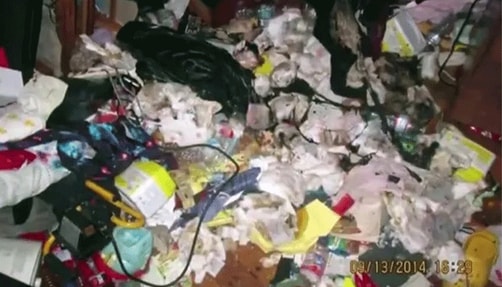
 Photo Credit: News Boston
Brown did what anyone in that position would do: call for help. When police arrived at the property, they were met with a scene that quickly escalated beyond a standard welfare check. They later described the smell as something so foul that it stayed with them long after they left, and one officer compared the upstairs to a landfill.
Other than the stench, they described the floors as covered in rubbish, the air thick with flies, and that maggots were visible in places where waste had accumulated.
Moving through the house was difficult, and in one bedroom, the door could barely be opened because of the sheer volume of dirty diapers, and trash piled against it. Human excrement marked the walls, and every surface seemed to carry evidence of prolonged neglect, creating an environment that was physically hazardous and deeply disturbing.
Long after officers left the property, it was not just the harrowing images that followed them, but the smell, the atmosphere, and the overwhelming sense that something had gone radically wrong within the confines of the bricks and mortar.
Erika Murray is questioned
During questioning, Murray revealed that her two youngest children had actually been born in secret. Their existence had been hidden not only from the outside world, but even from the people within the household itself; she claimed they belonged to a friend named ‘Michelle Ridgeway’, a woman who, as it later emerged, did not exist.
Murray had fabricated this story entirely, and even went as far as to create a fake online presence for this ‘friend’ - both of the older children had been misled into believing that the two younger girls were not their siblings.
This was a level of deception that wasn’t created on a whim, or on the spot, it suggested careful construction, with thought and time put into it, as an attempt to maintain control over a reality that had become far beyond disturbing,
As the investigators continued to search the property, the full extent of what had taken place inside the house began to emerge. Hidden within closets, and concealed among layers of rubbish and belongings, were the bodies of three infants.
This discovery shifted the case entirely, turning what had already been a severe case of neglect into a possible murder case.
From Severe Neglect to Possible Murder
Erika Murray claimed that the babies had been stillborn, but she did eventually admit that at least one of the babies had been born alive, and had lived for several days before dying. Within those several days, no medical help had ever been sought.
The births of the deceased children had taken place in secret, and whatever had happened to them afterwards is still a question no one is able to fully answer.
For investigators, the discovery of the infants was not just shocking, but a defining moment. It provided a focal point for understanding the extent of what had occurred within the house, and raised many immediate questions about how such events could have gone unnoticed for so long.
How had no one noticed? Whether it was the smell, the sound of children crying? But at the same time, such a discovery would have been an awful weight to bear for those who lived by.
The house itself became central to the narrative of the case, but its condition was so extreme that no amount of cleaning or reconstruction would probably ever make a difference, and a decision was ultimately made, and the house was demolished.
Although the house was torn down, it still needed emptying (as best they could), and clearing the property took more than ninety hours; a process that reflected the sheer volume of waste, and the severity of the environment that had been allowed to develop.
The house may have found a way to escape its condition, but for the children, it wasn’t so easy.
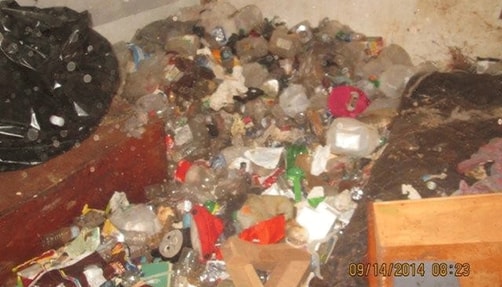 Photo Credit: Metro West Daily News
The children who survived Erika Murray's neglect
The condition of the surviving children was absolutely devastating - the filth and bacteria they had been living in is still something people cannot fully comprehend, or imagine.
The three-year-old, in particular, showed clear signs of severe and prolonged neglect; she had what was described as “doughy” muscle tone, which typically occurs when muscles aren’t used properly over time, such as walking, or even standing. She was unable to sit upright without support, which is something most children achieve within their first year.
The child was also non-verbal, and initially considered mute. She displayed significant trauma-related behaviours such as rocking, which is usually a form of self-soothing; she would also often curl into a fetal position, and avoid eye contact.
It seemed like whenever she was faced with anything unfamiliar or perceived something as threatening or frightening, she would literally try to make herself as small as possible. This kind of response is highly conducive of a child who learned to cope with a consistently threatening environment.
She also showed signs of sensory deprivation, and had become fixated on lights, likely because she had been deprived of normal visual stimulation. The child also suffered from severe nappy rash, her hair was unkempt, and there was a significant buildup of earwax, and most disturbingly, medical professionals, during the examination, saw and removed a maggot from one of her ears.
The five-month-old baby was not as severely affected developmentally, but was still clearly neglected. She was able to make eye contact and even smile, which was a positive sign, but she did not make typical vocal sounds expected at that age.
Physically, she showed delayed development, as she did not move normally, nor was she gripping objects, and she also did not kick as expected. Her arms were described as having “increased muscle tone”, meaning they were abnormally stiff and extended.
Medically, she was malnourished and had low levels of vitamin D, indicating a lack of exposure to sunlight, as well as low albumin levels (a vital protein produced by the liver) which pointed to poor nutrition overall.
Despite the severity of their condition, both children showed remarkable improvement once placed in foster care. The three-year-old, in particular, made rapid progress with her muscle tone improving significantly, and she was able to begin walking within just two weeks.
The two older children, the 10-year-old boy and the 13-year-old girl, were found to be slightly better physically than their younger siblings, but they were by no means unaffected.
The 10-year-old appeared to have taken on a level of responsibility way beyond his age as it was he who approached a neighbour for help when he couldn’t get his baby sister to stop crying - this kind of role reversal is often seen in neglect cases, where a child is forced into a caregiving position without the ability or support to do so.
While they may have received comparatively more attention from Murray than the younger children, they were still exposed to an environment that was beyond horrendous, and mentally scarring. Living in those conditions alone would have had a significant impact on their well-being, both physically and psychologically.
Erika Murray's Trial and Conviction
When the charges were brought against Erika Murray in December 2014, they reflected the scale of the case.
She faced accusations that included second-degree murder, alongside charges related to assault, neglect, and animal cruelty. The legal process that followed would take years, with the case eventually going to trial back in 2019.
In court, the focus shifted to questions of responsibility and intent - the defence argued that Murray suffered from significant mental health issues, and that not only was her intellectual capacity limited, but that she had been living under coercive control from her partner. These arguments introduced a different perspective, one that attempted to justify how the situation had developed to such an extreme point, and somewhat out of her control.
Ultimately, the jury did not convict her on the most serious charges. The murder accusations were not upheld, which was a decision that left many questions unresolved, and many people enraged.
The judge based this decision on the fact that the because the cause of death for the other children could not be determined, it couldn’t be said with certainty if they had been murdered by Murray.
Erika Murray was, however, found guilty of assault and battery and animal cruelty.
Although these charges acknowledged and punished Murray for the suffering of the surviving children, they did not fully account for the deaths of the infants found within the home; her sentence reflected that outcome, and Murray was given six to eight years in prison, a term that, by the time it was handed down, was already partially served.
The years she had spent in custody awaiting trial meant that her remaining time was limited, bringing the case to a close that felt, to many, incomplete, disrespectful to the lives of all the children, and with a punishment so lenient, like a punch to the stomach.
What remains is not just the record of what happened, but the lingering discomfort of a situation that defies any explanation.
The Blackstone house was more than just a location. It was supposed to be a family home, filled with love, warmth, and support, but instead it festered as an environment in which neglect, abuse, and isolation were allowed to grow unchecked until it ballooned into something even a seasoned horror fan would find repulsive.
It raises questions about how such conditions can exist without intervention, how warning signs can be missed, and what responsibility lies with those both inside and outside the home. This case, at its core, is not just about what was found within those walls of Blackstone House, but about what was hidden there for so long, and who should be held accountable.
Featured images: NBC News, News Boston, Metro West Daily News


