When we think of plants, we may picture beautiful tall trees, brightly blooming flowers, and gorgeous red roses. But as with everything that brings beauty, an alternative, darker side looms…
There are many wonderful plants out there, including fungi, which we attribute to certain seasons or holidays. But what about the plants and fungi that aren’t associated with the coming of spring or the warmth of summer?
What about the plants that are enough to fuel your nightmares?
Let’s journey together through these top 10 creepiest plants and fungi. It may get dark, but remember, there can still be beauty in the macabre.
Doll’s Eyes, Actaea Pachypoda
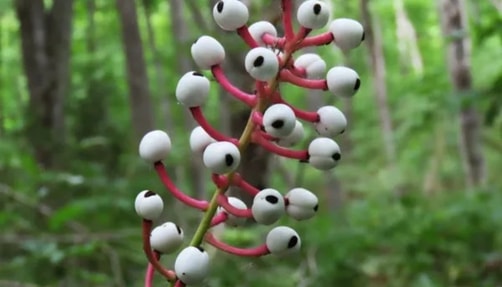
 Photo Credit: Oakland County Blog
Doll’s Eyes, depending on who you ask, can be visualized as big, bright blue child-eyes or black, soulless eyes that stare at you from across the room. But in the world of plants, they may be even worse.
This particular plant gets its name from the distinctive porcelain white fruits which have a black speck dotted in its center, resembling the old-fashioned dolls eyes of China dolls.
The plant, with its red stems and staring eyes, would be enough to unnerve anyone who comes across its path, but it’s freaky appearance isn’t it’s only surprising element. Although its berries can be eaten by birds, consumption by humans can cause severe stomach cramps, dizziness, burning of the throat and mouth, diarrhea, and hallucinations.
So, whether you find this particular plant beautiful or creepy due to its striking appearance, remember those little dolls eyes aren’t as appetizing as they may look…
Corpse Flower, Titan Arum
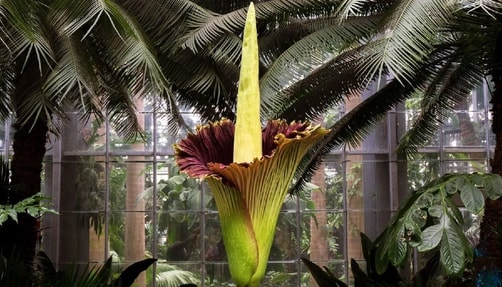 Photo Credit: Britannica
This rare Corpse Flower, believe it or not, is one of the smelliest plants on Earth.
The nickname given to this plant is due to the incredibly foul smell it emits; the stomach-turning odor is produced to attract pollinators that feed (and breed) on rotting flesh, such as carrion beetles, and flesh flies.
The Corpse Flower can grow up to 12 feet tall. It has a large inner flower spike surrounded by a large petal-like collar, which is usually cream colored on the outside, as well as a dark-purple color on the inside, to help sell its rotting flesh vibe.
Its flower spike actually produces heat in order to help its stench travel and attract pollinators from over 1500 feet away.
Despite its appearance, the Corpse Flower isn’t carnivorous. Better yet, its dead-meat odor is only emitted for a single evening when the plant is in bloom.
And yes, this plant is poisonous, so if you fancied a bite (not recommended), remember the plants contain calcium oxalate crystals, which are toxic when ingested.
Pitcher Plants, Nepenthes
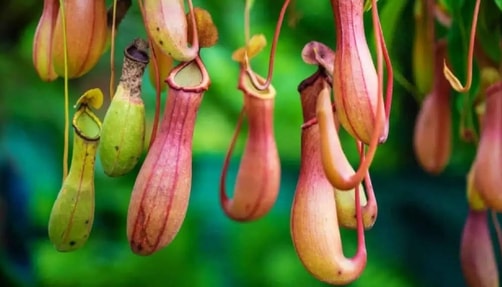 Photo Credit: Planet Natural
Pitcher Plants are carnivorous plants that have leaves known as pitfall traps. Although these plants may look unsuspecting, their pitfall traps are prey trapping sacks that feature a deep cavity filled with digestive liquid.
The plant attracts its prey with its colorful lids and the smell of sweet nectar. However, the pitfall traps have slippery rims that cause the insects to fall into the pits, which also have downward-point hairs and waxy walls to prevent anything from escaping.
Depending on the size of the Pitcher Plant, it is not just bugs that fall prey—mice, frogs, and other small vertebrae can become trapped.
These plants, however, can be grown and kept at home, as they are great for getting rid of pesky bugs. Although, having a few potted stomachs dotted around your home may make you feel uneasy.
Ghost Pipe Plant, Monotropa Uniflora
.jpg?w=3840 "ghost-pipe-plant_creepiest-plants-and-fungi") Photo Credit: PennState
Photo Credit: PennStateThis ghostly wildflower gets its name from its ghastly white appearance. They can grow up to eight inches tall, and their thin, white stems are shrouded in semi-transparent, shrunken leaves.
Ghost Pipe plants are completely white, as they lack the green pigment, chlorophyll, that most other plants use to photosynthesize.
That brings us to this plant's otherworldly trait; as it doesn’t photosynthesize, this plant is known as a parasite. They survive by stealing nutrients from mycorrhizal fungi that grow around the roots of trees.
Mycorrhizal fungi help trees to take up water and minerals from the soil, and, in turn, they take nutrients from the tree sap for their energy needs. Ghost Pipes take advantage of this symbiotic relationship in order to survive.
Dead Man's Fingers, Xylaria Polymorpha
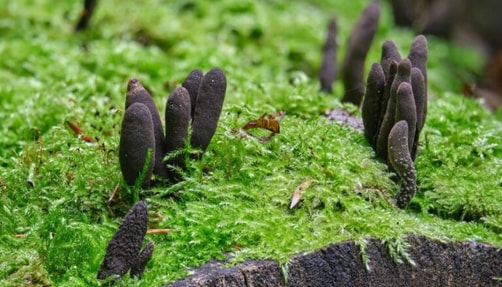 Photo Credit: Office of Research
Dead Man’s Fingers are a spooky sounding—and looking—fungi that can be found in woodlands throughout the UK, Ireland, mainland Europe, and North America.
These creepy fungi gain their name from the swollen, blackened “fingers” that seem to reach out of the ground like a zombie trying to escape its burial ground. The fungi actually grows inside rotting or cracked wood.
Dead Man’s Fingers protrude from the earth in clusters of three to eight fingers, at around one to four inches in height, and are usually black or brown with blue-ish or greenish tones.
These particular fungi do not look appetizing; their appearance, a strong resemblance to bloated, zombified fingers clawing their way out of the ground probably do not really scream “yummy.”
Which is probably a good thing, as they contain amatoxin and phallotoxin, which are compounds found in some of the world's most deadly mushrooms.
Devils Tooth Fungi, Hydnellum Peckii
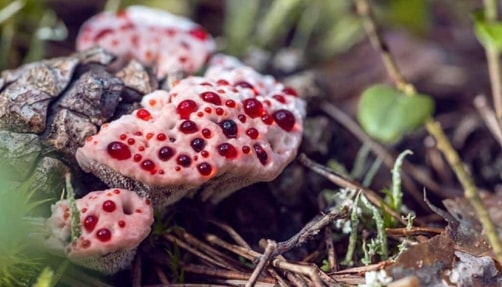 Photo Credit: Mushroom Appreciation
If there is one thing you can be certain of in life (apart from death and taxes), it’s that there will always be a plethora of mushrooms to add to a “top creepy list.” This particular fungi is a perfect specimen.
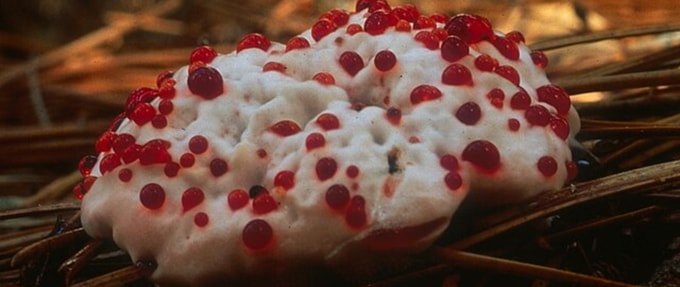
The Devils Tooth Fungi, or the “Bleeding Tooth” mushroom, consists of a cream colored, spongy body that is littered with red oozing spores, similar to that of blood droplets.
It is believed that the red oozing liquid is a means of transpiration. When the fungi detects too much moisture, water is forced out of the glands from the stems.
This macabre mushroom seems to “bleed” after rain or high-humidity conditions.
Although not toxic, this fungi isn’t known for its pleasant taste. It may look like Tim Burton's take on strawberries and cream, but the Devils Tooth mushroom is well known for its extremely bitter taste, making it pretty inedible.
Zombie-Ant Fungus, Ophiocordyceps Unilateralis
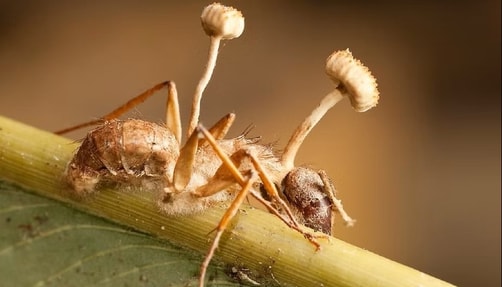 Photo Credit: Khao Sok
Now this is what nightmares are made of! The Zombie-ant fungus.
This insidious sounding fungus has only one goal: to infect and spread. This parasitic fungus hijacks ants’ bodies before slowly devouring them from the inside out and turning them into the walking dead.
Like in most zombie infection lore, this fungus doesn't instantly kill. It has an incubation period, and the ant will go about its daily business unscathed and undetected by other ants, who usually exile sick members to protect the colony.
As the infection takes hold, the fungus will compel the ant to leave its nest and find an environment better suited to the fungus’ growth. The ant will find a leaf, around 10 inches off the ground and clamp onto it.
The fungus will feed on its innards until the ant expires. Several days after the ant has died, the fungus then sends a fruiting body out of the ant’s head so it can catapult more spores into new unsuspecting ants.
The Devil's Gut, Cassytha Filiformis
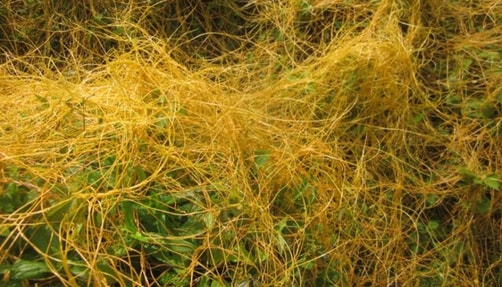 Photo Credit: Wild Blessings
Another parasitic nightmare is the Devils Gut plant, also known as “Witches Hair,” which is a pretty good description of what this plant looks like.
It is a plant with no leaves, no roots, and no way to photosynthesize. Instead, this creepy plant uses tiny root-like structures known as haustoria to attach to other plants.
The haustoria pierces into its host and sucks out its nutrients like a stringy vampire.
A lot of plants have evolved defenses against The Devils Gut plant, such as releasing toxins or even killing off the part being attacked, but this is where the parasitic plant unfortunately wins out.
It has actually figured out a way to take control of a plants host genes in order to stop or suppress the victims defense responses.
The Darth Vader Flower, Aristolochia Salvadorensis
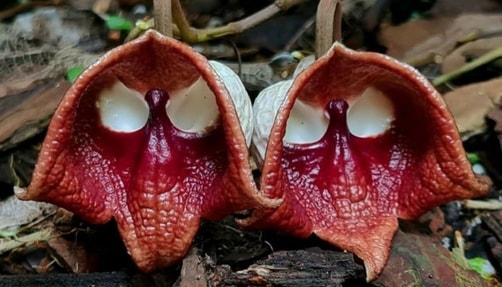 Photo Credit: Fairchild Garden Explorer
Can something be creepy but also seriously cool? Yes, and that is the Darth Vader flower.
Named after its eerie resemblance to Darth Vader's mask, this species is a rare tropical flower that attracts flies via a scent of rotting flesh.
Insects, when attracted to the stench, momentarily get trapped within its sticky hairs, covering the victim in pollen before being released, allowing more blooms to be pollinated.
Not only does this plant look like a Dark Sith Lord, it is also nearly as dangerous as one. It contains the toxin aristolochic acid, which, if ingested, can cause kidney failure.
It may be worth sticking to the high ground to avoid this one…
Jackal Food, Hydnora Africana
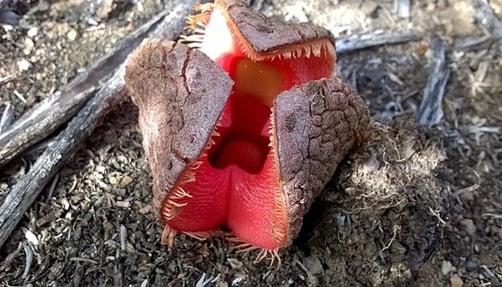 Photo Credit: Wikimedia Commons
There aren’t many creepy plants that make you feel like busting out a musical number, but this one just might (Feed Me)!
The Jackal Food plant is another species that emits a pungent odor (what is it with that?) to attract carrion beetles to help spread its pollen.
Its bizarre appearance has been compared to something from Alien, but also the man-eating plant from Little Shop of Horrors; although, the real-life plant isn’t carnivorous, it survives by parasitic means, getting its water and nutrients from a host plant.
The creepy plant is mostly hidden underground and is attached to its host plant by a root-like structure, haustorium. After rainfall, its flower will bloom above ground and attract insects to pollinate due to its foul odor.
The flower can grow up to six inches tall, and has a brown, cracked interior and a vibrant orange inner, with the edges sprouting what look like little jagged teeth.
Creepy, alien, and smelly—not exactly a valentines day gift!


