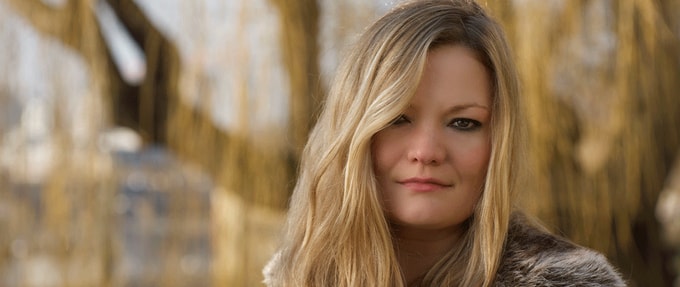

Memory is one of many thematic road signs you often encounter while traveling through the various settings in Catriona Ward’s books. The Tor Nightfire author was born to English parents in Washington, D.C. Her father was an international economist, so the family moved around a lot, and she grew up all over the world, including in the United States, Kenya, Madagascar, Morocco, and Yemen. The moorlands of Dartmoor in Devon, South West England was the one cherished place the family returned to on a regular interval. Ward attended Bedales School and went on to study English at St. Edmund Hall, Oxford. She then tried pursuing her “incredibly unsuccessful career as an actor.” She really wanted to make that work, but she kept hitting an impenetrable wall.
“I think there was an impulse in that desire [for acting], which actually carries over into the writing,” says Ward over a Google Chat before the release of her latest novel, Nowhere Burning. “They're both forms of storytelling, aren't they? And I think I got the wrong one. So I started writing for this Human Rights Foundation and doing articles and things like that. Very, very different sort of content as to the stories that I write now, but it was advocacy and journalism and things like that. But it sort of just lit this little match, after articulating other people's points of view, and doing essentially what was the form of ghost writing.”
Ward started writing short stories and novels for herself, turning over her ways of expressing herself like rough stones from a stream in need of a good polish. She’s told the story about when she was 13 years old many times before, from her summers in Dartmoor. “I started waking up in the night with this hand in the small of my back, and I could feel every single finger on the hand,” recalls Ward. A terrifying anecdote worth retelling.
Ward later learned that what she experienced in Dartmoor and other homes was actually a “hypnagogic hallucination.” “I sort of had this impression that I was the haunted one,” notes Ward.” “It wasn't the place, it was me, and gravitating towards a ghost story and finding a means of expression to share that fear, because I think that's what the darker side of fiction and horror are.”
Ward believes horror books are a “profound means of sharing” and the genre demands more of the reader and the writer than any other genre. “[Horror] is a conduit for empathy, really for sharing your fears,” argues Ward.
In the spirit of empathy, The Lineup took some time on a Google Meet call to discuss with the British Fantasy and Shirley Jackson Award-winning author on the eve of her Neverland Ranch-inspired novel, Nowhere Burning. We flip through her fears, memories, and accomplishments from her first six novels.
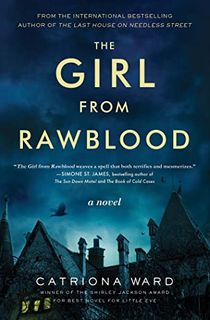
The Girl from Rawblood: A Gothic Horror Story
When Ward returned to London, she worked on her first novel while writing for a human rights foundation until she left to take an MA in Creative Writing from the University of East Anglia. That novel, Rawblood (distributed in the United States as The Girl from Rawblood), was published in 2015.
The Girl from Rawblood is a gothic horror from toe to tail and follows protagonist Iris Villarca, the last of her family line, who lives in isolation at the haunted mansion Rawblood on Dartmoor, haunted by a curse that brings death to those who fall in love. The book follows Iris as she tries to investigate a generational curse and a classic setting haunted by loss, love, and plenty of secrets.
“I think maybe Raw Blood is quite academic gothic, maybe that was also a way of working through the idea that writing is a subject for study, trying to relate to my own experience as a reader,” says Ward. Ward laments wasting seven years writing and rewriting that book.
“I was teaching myself to write as I was writing, and I think I also spent a lot of time making sure that every single section was completely idiomatically correct for the period. So there would be no words used in any way, shape, or form that would not have been used during the specific eras that they're set in.
As a result of all that tinkering and polishing, The Girl from Raw Blood is a great love letter to the Gothic genre.
Ward feels a bit sheepish talking about her debut over a decade later. “My older books, partly, you are in a different world than what I’m creating now, and it just seems like a foreign country, but particularly with Raw Blood, it just feels like such a photograph of my younger self, and it's a bit emotional,” she admits. She likens it to looking at a picture of yourself as a child.
“You are kind of like, ‘oh gosh, baby writer,’ but I think it was the one that I had to move through to get the rest.”
The novel’s beautifully lush prose ultimately garnered a British Fantasy Award in 2016, so all those years of polishing ultimately paid off.
Little Eve
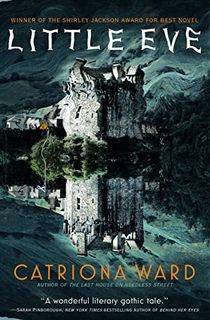
Little Eve’s Scottish island setting is utterly unique. The dueling stories of two orphaned girls, Dinah and Eve, are set against an isolated, sea storm-battered Scottish isle of Altnaharra, connected to the mainland by a causeway.
This gothic horror tale has a wild quasi-religious cult led by a man named “Uncle” who worships the Adder snake deity. Unreliable narrators, a gastropod shell-like narrative structure, and the lasting psychological damage from cults rightfully earned a Shirley Jackson Award.
Despite the recognition, Ward notes that Little Eve “sold minus copies” the first year it was out. “I didn’t even know that was possible,” she laughs.
One of Ward’s best lines from any of her books comes from an Evelyn chapter: “I don't know, which is worse, suffering or the memory of it? Memory perhaps because memory does not end.“
It truly encapsulates what is so enjoyable about horror reading and many of Ward’s novels. Memories dredge up the most insecure and fearful sides of ourselves, like sea life scurrying across the ocean floor.
Ward was proud of finishing Little Eve (late, but faster than Rawblood), despite the initial poor sales. Her mother was born in Scotland, and grew up all over the tropics like her, so there was a real pining for the old country whenever her mother got together with her brothers and sister and spoke in their “wee Scottish accents.”
For Ward, Little Eve is about “the comfort and danger of families and found families, and what verges on a cult where truth and perception are very blended.” “How far can they bend your sense of reality when people are left entirely insulated and isolated?” Belief, superstition, science, and religion all swirl together as Dinah and Eve wrestle between two very different parental figures, the punishing Uncle who wants to keep them on the island, and the inspector who visits the island to investigate a crime.
There are a lot of animals in all Catriona Ward books, but Little Eve’s god-life snake is wholly unique. “I think that was my big turning point,” notes Ward. “I moved a bit away from these historical fiction idioms and [a certain way] of writing, and started to find a language and style of my own.”
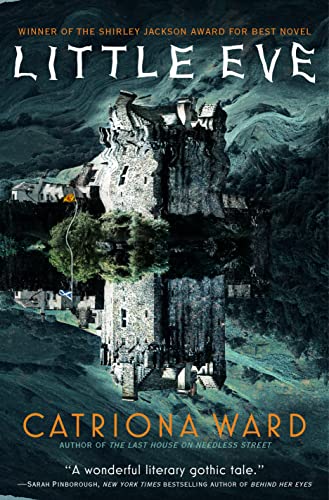

The Last House on Needless Street
For the serial killer novel The Last House on Needless Street, Ward wanted to write something really ambitious and try to take it to a very heightened and new place for both characterizations and setting.
She initially pulled the setting idea from a memory of taking a long drive with her father when she was about 15 in Washington, D.C. They took left turns for five hours on a free and sunny weekend day until the road ended somewhere out in Virginia.
“And eventually the road did end, and it ended in this lovely dappled forest, with a dirt road leading to a river,” remembers Ward. “We drove through so many landscapes, and so many different sceneries, and I realized that I'd never really used that [for a book]."
Ward started recovering more nice scenic memories of the American landscape, like the way the light falls in the Blue Ridge Mountains after a storm. She also really wanted to tell a dark story from a naive animal’s point of view — a serial killer’s cat story.
The book wasn’t working at first until she stumbled upon some material about dissociative identity disorder, and the pages flew from there. “That book was one of the more humbling experiences in my life,” says Ward. “I am so grateful to the people who spoke to me for it. And a couple of them said that they didn't want to read it afterwards."
Ward definitely did not want to use the disorder as a plot device or demonize it in any way. Ward still misses and dreams about Olivia the cat. “It comes back to empathy again, doesn't it?”
Plus, a serial killer’s actions are that much more chilling when a talking lesbian, Bible-reading cat is saying it all with a dry wit.


Sundial
Sundial takes Catriona Ward readers from the rain-soaked Pacific Northwest to the Mojave Desert. The story is also about sisters before it gets to ghosts, remote-controlled dogs, and government experiments.
“Having had such an isolated childhood, my only continuous friend for most of my life until I was in my mid-teens was my sister,” recounts Ward. “If you move from Kenya to Madagascar, you're not going to take friends with you. She notes there is a real resilience of that sisterly bond, but in a writer’s mind, they are always looking for ways it can all unravel.
The Mojave Desert served as another liminal space for her characters to roam and a book structure that was more straightforward, like a grocery store psychological thriller novel.
“There are wonderful writers like Sarah Pinborough, who wrote Behind Her Eyes and all sorts of other things, who do these absolutely fantastic domestic noir novels,” posits Ward. “I wanted to dip my toe into that and see, and then of course you realize it's actually about remote-controlled dogs and a compound in the desert.”
As the story spins off, Ward wanted the dogs to be connected to her research of declassified CIA documents she found on the CIA archival site, The Black Vault.
“It's quite redacted, but The Black Vault is basically a big dump of declassified CIA documents,” says Ward. “On that site, you can find and actually see very faded pictures of the remote-controlled dogs that they made at Langley and then destroyed because there was no purpose to it at all. Seems very cruel to me."
Ward was fascinated by all the physical details about how they did it with the little caps on the heads of the dogs and how they fitted the electrodes into their limbic systems.
“When I first read it, I was like, ‘how has no one written about this before!?’”’
Ward calls it a “great violation of this covenant that we made with dogs.”
“Humans domesticated dogs before we domesticated really useful things like cattle. And maybe it's [for] hunting, maybe it was for protection, but it was also for friendship.”

Looking Glass Sound
In the middle of writing this book, Ward was celebrating her birthday when her boyfriend looked up at her and said, “I can’t feel my legs.”
He has this thing called Gilbar syndrome, but it’s completely curable, and it’s absolutely fine.” He had to learn to walk again. “I think a lot of my fear, anxiety, and sorrow made its way into the book in that sort of filtered, transformed, and catalyzed way that things do.”
There are no direct references to what happened in real life, but Ward sees a novel that changes almost in your hands as you're reading it.
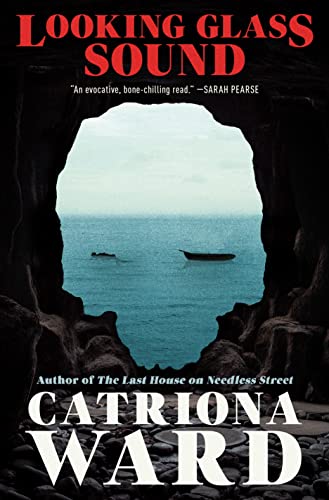
Looking Glass Sound is another unsettling psychological horror story, following writer Wilder Harlow as he writes a memoir about a dark summer in Maine, a serial killer known as the “Dagger Man,” and his childhood friends, all while fighting through a time loop trap. The metafictional narrative cycles through themes of friendship, hazy memories, and finding your true identity.
Like many writers, Ward was influenced by Stephen King. “His books are definitely friends to lonely children,” says Ward.
“He just has such an insight and a perspective for identifying these wonderful moments of adolescence, but also just by coming into existence, they also become moments of loss because you are growing up, even as you live them, like in Stand by Me and [the original novella] The Body.”
You’ll never have the friends you had in your preteen years, and Harper’s two friends hanging out on the beach in the summertime are an indelible image for Looking Glass Sound and a lovely strip of psychological terrain from Ward’s global-trotting bibliography.
Nowhere Burning
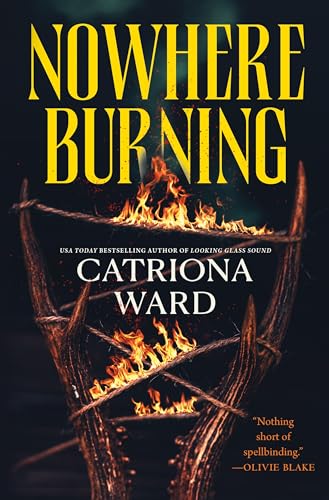
We wrap up our novel travelogue in Colorado’s Rocky Mountains, with Nowhere Burning. Catriona Ward weaves a fever-dream of Peter Pan, Michael Jackson’s Neverland Ranch, shifting family identities, and deep folk-horror trauma.
The book follows a wandering brother and sister, Riley and Oliver, who grow up far too quickly and whose realities are less a solid floor and more a thin moat over an abyss with a crocodile snapping its jaws. Ward’s characters are ghosts in their own lives, allured by the once-magical, now burnt-down Nowhere and its odd actor king, Leaf Winham.
The jagged edges of a past that refuses to stay buried live there. It’s a claustrophobic, sensory exploration of how grief can literally reshape the world around us and how we’re similar to the runaways fleeing grief by stumbling into new dangers.
The narrative interrogates the reliability of our own minds, emphasizing that our recollections are often just survival mechanisms. As Ward poignantly writes in the first line of the book: "Some people attract death. It loves them, twines around them like ivy, follows them all their lives."
The story is worth exploring, even as it meanders through the Nowhere maze a bit. It’s a brutal, beautiful descent into folk horror where the fire isn't just external—it’s the soul turning to ash.
“I had to put [Nowhere Burning] down halfway through [writing it], when my mother came home for the last time,” recalls Ward through some tears. “And so I was looking after her, and afterwards I just, not only did I think I would never finish this book, I never thought I'd write again.”
We mention how our mothers were our biggest champions for our writing and commiserate over the call. “It's extraordinary, isn't it? It's a terrible secret club,” says Ward.” “I remember when other people lost parents when I was younger…but no one can quite explain the great tear it makes in your heart. Ward feels lucky.
“But like you were saying, one of the last things she ever said to me was, ‘don't stop writing.’ Ward showed up at the desk, and it wasn’t writing at first, only typing, but she hoped that if she just showed up long enough, the book and her writing would come back. She notes that the love that Riley has for Oliver and Mark’s love for his daughter in Nowhere Burning were amplified because of her personal tragedy.
“I think I found a place to put that love and that pain, if you will,” says Ward.
“But it was not easy at all. So I'm very cautiously proud of it. I think for me, it's my best book. Well, I hope it is. I mean, you always want your last one to be your best one.”
Featured image: Robert Hollingworth


