
Late at night on a rural British road, the headlights rarely reveal much. A strip of pale tarmac ahead, hedgerows on either side, perhaps the occasional road sign catching the beam. Most of the time, that is all there is to see.
Yet drivers sometimes describe something else appearing briefly at the roadside. A person standing alone where no one would normally be walking at that hour.
For much of the twentieth century, such a sight would not have seemed unusual. Hitchhiking was once common across Britain. Students traveling between universities relied on it, soldiers heading home on leave often used it, and in rural areas where buses ran infrequently, it was sometimes the simplest way to reach the next town.
Drivers stopped more readily than many people might imagine today. Traffic was lighter, journeys shorter, and offering someone a lift for a few miles was rarely considered remarkable.
By the late 1980s, that culture had largely faded. Bus routes improved, car ownership increased, and attitudes toward roadside strangers began to shift. Hitchhiking did not disappear entirely, but it became far less common.
The stories connected with those encounters, however, did not disappear so easily. Across Britain, there are accounts from motorists who stopped for a lone traveler only to realize later that the passenger was no longer in the vehicle.
No door opening. No explanation. Just the odd moment when the driver glanced in the mirror and discovered the seat behind them was empty. Folklorists eventually grouped stories like these under a familiar title: the vanishing hitchhiker.
One of the places most frequently associated with the legend lies on the slopes of the North Downs in Kent…
Blue Bell Hill
Drivers passing along the road near Blue Bell Hill have shared unusual stories for decades. The road runs along a chalk ridge overlooking the River Medway, and once darkness settles across the surrounding countryside, the area can feel surprisingly remote despite being only a short distance from nearby towns.
The location first gained attention after a fatal accident in November 1965. Three young women were killed when their car collided with another vehicle at a junction along the road. The crash was widely reported in Kent newspapers and remained in local memory for years afterward.
Within a few years, drivers began mentioning something strange along the same stretch of road. Several motorists said they had seen a young woman standing beside the roadside late at night. The descriptions were similar enough to attract attention.
Witnesses often said she appeared pale in the headlights, sometimes dressed in light-colored clothing, and positioned close to the junction where the accident had taken place. In some accounts, drivers slowed down and stopped, assuming the woman needed a lift.
She entered the car quietly. An address was given. The journey continued. Then, a few miles later, the driver glanced into the rearview mirror. The seat behind them was empty.
Kent newspapers mentioned the sightings from time to time during the 1970s, usually in short reports about unexplained incidents along the road. Paranormal researchers later collected statements from drivers who believed they had encountered the same figure.
None of the accounts could be confirmed, but the repetition of the story was enough to give the road a lasting reputation. Blue Bell Hill is still mentioned today whenever British ghost stories come up in conversation.
The A75 in Scotland
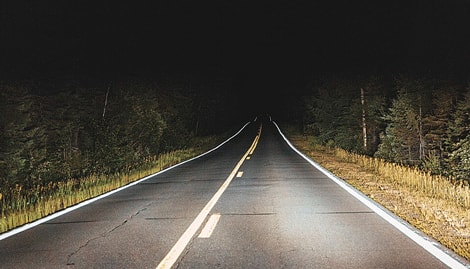
 Photo Credit: Wikimedia Commons
Far to the north, another road developed a reputation of its own. The A75 road crosses the quiet countryside of Dumfries and Galloway, linking the town of Dumfries with the ferry port at Stranraer. Large sections pass through open farmland where traffic becomes sparse late at night.
During the 1960s and 1970s, drivers began reporting strange encounters along one stretch, sometimes referred to locally as Kinmont Straight. Several motorists described seeing figures standing beside the road after dark. In some cases, the person appeared to wave as though asking for a lift. In others, the figure stepped briefly into the headlights before disappearing again.
One driver later described suddenly braking when a man appeared to walk directly into the road ahead of the vehicle. Expecting a collision, the driver stopped the car. The road was empty.
Police occasionally received reports of unexplained figures seen along that stretch of highway, though searches of the surrounding fields rarely located anyone nearby. Over time, the road developed a quiet reputation among local drivers.
A Devon Roadside Story
Not every British phantom hitchhiker story became widely known. Some circulated locally for years before being recorded by folklore collectors. During the 1970s, several motorists traveling through rural Devon reported encounters with a young woman waiting beside narrow country lanes late at night. According to the accounts, she asked for a lift to a nearby village, only a few miles away.
Drivers who stopped said she appeared withdrawn and spoke very little during the journey. She usually sat in the back seat while the car moved slowly through the dark countryside. Then the driver would glance behind them and notice something strange. The seat was empty.
Local newspapers mentioned the sightings briefly at the time, though they never attracted the attention given to the Blue Bell Hill reports. What interested folklore researchers later was the similarity between the different descriptions. Separate drivers, traveling on different nights, seemed to describe the same encounter.
A Derbyshire Account
Another example appears in folklore collections connected with the A38 in Derbyshire. In one account, a driver traveling late at night noticed a solitary figure standing beside the road and signaling for a lift.
The driver stopped. The passenger climbed into the back seat and gave the name of a nearby village. For several miles, the journey continued normally through the dark countryside. At one point, the driver glanced into the rearview mirror. The back seat was empty.
Stories like this appear across Britain in slightly different forms. The roads change. The witnesses change. Yet the structure of the encounter remains remarkably similar.
Why the Stories Persist
Folklore researchers eventually noticed how often the same narrative appeared in different places. The vanishing hitchhiker legend has been recorded across Europe and North America, usually associated with specific roads or local tragedies.
British examples fit comfortably within that wider pattern. In many cases, the stories probably begin with ordinary experiences. Headlights distort shapes. A distant shadow at the roadside briefly resembles a person before resolving into something else entirely. A driver later retells the moment, and the story gradually takes on a life of its own.
Once the pattern exists, new accounts naturally follow it. Even today, long after hitchhiking has largely disappeared from British roads, drivers occasionally mention seeing a solitary figure standing beside a dark stretch of countryside.
The car slows. For a moment, it seems someone might need a lift. Then the headlights reveal an empty roadside…
Featured image: Wikimedia Commons


