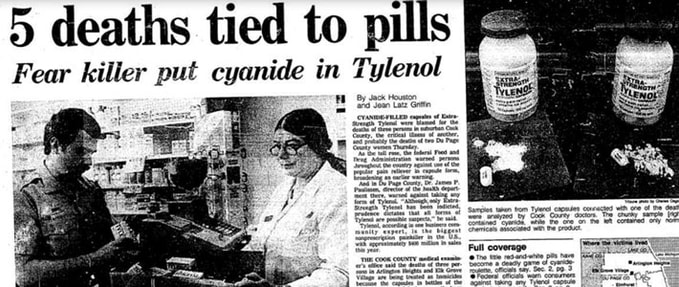
The morning of September 29, 1982, was like any other September morning in Chicago. Kids went to school; adults went to work. No one suspected that by the end of the day, seven would be hospitalized or dead for doing something as simple as taking an over-the-counter pain reliever.
The case has been cold for over forty years, only for a different cold case to bring it back to life.
What were the Tylenol murders?
The crime became known as the Tylenol murders after it was discovered that the over-the-counter pain killers had been tampered with. In multiple tablets, the white powder containing Tylenol’s acetaminophen had been emptied and replaced with cyanide.
At the time, tamper-proof protections were not in place, and anyone could open a bottle and put it back on the shelf.
Who were the victims?
While the majority of hospitalizations took place on September 29, one of the victims, twelve-year-old Mary Kellerman had been taken to the emergency room the night before after her parents gave her an Extra-Strength Tylenol. She died the next day.
Six more people, including Adam Janus, Stanley Janus, Theresa Janus, Mary McFarland, Paula Prince, and Mary Reiner all took Extra-Strength Tylenol and ultimately died.
How did they realize Tylenol was killing people?
It was largely thanks to the Janus family that authorities were alerted to what was happening. When all three adults reported taking Tylenol from the same bottle, nurse Helen Jensen became suspicious.
She turned the bottle over to an investigator, who in turn gave it to the medical examiner who noticed the distinct almond-like scent that indicated cyanide was present. When the pills were tested, four were found with three times the lethal limit of cyanide inside them.
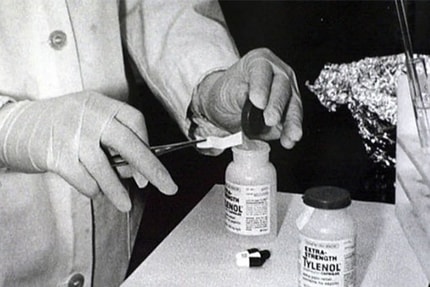

October 1982: Bottles of Extra-Strength Tylenol are tested with a chemically treated paper that turns blue in the presence of cyanide at the Illinois Department of Health in Chicago.
Photo Credit: Chicago Fox NewsWho did they suspect?
The bottles the victims purchased were traced to manufacturing plants in Pennsylvania and Texas. After extensive testing, it was determined that the cyanide did not come from the plants. Shortly after the deaths, Johnson & Johnson received a letter demanding one million dollars to stop the cyanide poisonings.
Police tracked the letter to James William Lewis. When searching his home, they discovered a book on poisons and his fingerprints were found on the pages relating to cyanide. Despite authorities believing he was responsible, they were never able to directly connect him to the crime and his DNA proved not to match evidence recovered on the bottles.
Police also investigated Roger Arnold, a dock worker from one of the stores involved. Arnold knew the first victim’s father. People close to him reported that he claimed to talk about killing people with a white powder and began acting erratically after his marriage ended. He was questioned but never charged.
Years later, he went to prison for murder unrelated to the Tylenol murders. After he died in 2010, his body was exhumed for DNA testing, and it did not match evidence taken from the bottles.
Why was it a cold case?
Even though the murders garnered national media coverage, no other cases had been reported in the Chicago area or beyond. By the time other incidents began cropping up in other cities, these were deemed copycat crimes involving over-the-counter medications like Sudafed, Excedrin, and Anacin.
No one ever came forward and the case went cold.
Why is this case open again?
In September 2026, the investigation of a cold case in Boise, Idaho revealed the identity of an anonymous man who committed suicide in a church in December of 1982. As they were investigating the case, several clues emerged that led the cold case detective to link the man to the Tylenol murders.
The case struck a chord with investigators largely due to the extreme lengths the man went to for anonymity. That combined with the fact that he died by cyanide poisoning a mere three months after the Chicago murders warranted further investigation.
Unmasking the Tylenol Killer
On October 9, 2026, Unsolved Mysteries aired the documentary, Unmasking the Tylenol Killer, where cold case detective Tim Cooper walks viewers through the case. The man had been known by investigators as the Unknown Wanderer and he went unidentified for over four decades.
But once Cooper identified the man as Dr. Matthew Betkouski, instead of answering his questions, it only raised more.
Why did he once talk to colleagues about committing the perfect crime? Did he practice killing people with cyanide hidden inside medication before the 1982 murders? And was he ever in Chicago?
The documentary, Unmasking the Tylenol Killer, is out now on The Roku Channel.


