St. Margaret’s Church stands above the village of Ratlinghope in the Shropshire hills. Among the graves in the churchyard is one belonging to Richard Munslow, a local farmer who died in 1906.
The stone itself is easy to overlook. There are older graves nearby and larger monuments elsewhere in the churchyard. Yet this modest memorial attracts visitors from far beyond the village.
Munslow is frequently connected with one of Britain’s most unusual funeral customs. According to local tradition, he was a sin eater.
Whether he was the last person to perform such a role is another matter. The evidence surrounding sin eating is rarely straightforward. Some accounts were recorded years after the events they describe. Others survive through local histories and recollections gathered long after the custom had faded from everyday life.
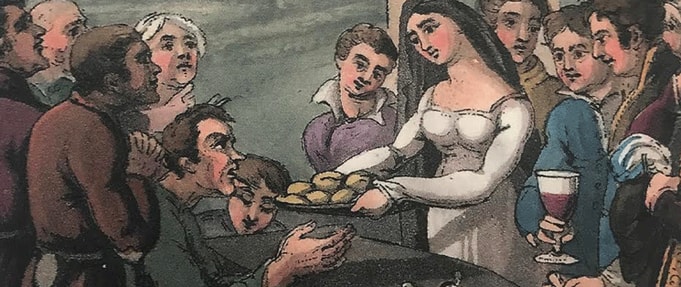
The details vary depending on the source. Certain elements appear again and again, however. Bread. A dead body. Someone willing to consume the bread on the deceased's behalf.
That much remains surprisingly consistent.
Bread on the Body
One of the earliest references comes from the seventeenth-century antiquarian John Aubrey.
His note is brief. Frustratingly brief.
Aubrey describes bread being laid upon the body before passing to the individual expected to eat it. Beyond that, he leaves readers with very little to work from.
Later researchers have returned to those few lines repeatedly. Not because they are detailed, but because early references to sin eating are uncommon.
Questions remain. The surviving accounts rarely explain who became a sin eater or how often such rituals occurred. In most cases, they do not even attempt to answer those points.
The records leave gaps. Quite a few of them.
Later writers recorded similar traditions. In the nineteenth century, the clergyman Matthew Moggridge described customs from Herefordshire in which bread and ale were offered to a designated individual following a death.
Moggridge’s account is not identical to Aubrey’s, although the similarities are difficult to miss.
A symbolic transfer. The sins of the dead pass to the living.
Between Church and Custom
These were communities where church attendance was routine and where most people expected religion to provide answers about death and what followed afterward.
This did not make sin-eating an official church ritual. Far from it.
Clergy were often uneasy about customs that appeared to operate alongside established religious practice. Yet local traditions rarely concerned themselves with theological neatness. Villagers facing death were often more interested in what seemed useful than what appeared in formal doctrine.
A sudden death could leave difficult questions behind. Had the person confessed? Had they settled their affairs? Had they met death prepared?
The sin eater appears in that uncertain space. Not as a priest. Not as a church official. Something else.
For grieving families, the ritual may have offered reassurance at a moment when little else could be done.
The People Nobody Wanted to Become
Popular culture has been rather generous to sin eaters.
Modern novels, films, and television productions often present them as mysterious wanderers carrying secret knowledge. The surviving descriptions suggest something rather less dramatic.
Most accounts place sin eaters near the edges of society. They were often poor. Some seem to have lived relatively isolated lives. Few descriptions suggest individuals held in particularly high regard.
That may not be surprising.
If people genuinely believed that sins were being transferred, the role carried an uncomfortable implication. Each ritual added another burden. Every funeral left something behind.
Village life already had people who dealt with uncomfortable necessities. The gravedigger is an obvious example. The executioner another. Communities needed such individuals, but that did not always translate into social acceptance.
The sin eater appears to have occupied a similar position. Useful when required. Best to avoid the rest of the time.
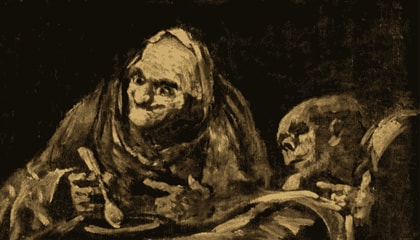
 Photo Credit: Wikimedia Commons
Richard Munslow and the Shropshire Tradition
Eventually, the trail leads back to Shropshire and to Richard Munslow.
Researchers examining the subject usually encounter Munslow sooner or later.
According to local tradition, Munslow began performing sin-eating rituals after suffering a series of personal losses, including the deaths of several of his children.
It is a powerful story.
Here, the ground starts to shift a little. Some details appear in local tradition rather than contemporary records. As with many old customs, later retellings sometimes become difficult to separate from earlier evidence.
That uncertainty is not unusual. Village traditions rarely arrive supported by extensive records. More often, they survive through recollections, local histories, and stories repeated long after the people involved have disappeared.
Whether Munslow was truly Britain's final sin eater remains uncertain. He is certainly among the last people firmly associated with the custom.
His grave survives. The stories survive. That alone is enough to keep researchers returning to Ratlinghope.
Did Sin Eaters Really Exist?
It sounds like an odd question after several centuries of references, yet historians continue to debate aspects of the tradition.
References turn up often enough. The difficulty comes when deciding how much weight to place on each one.
Some researchers argue that antiquarians occasionally exaggerated unusual customs because unusual customs made for interesting reading. Others point to the consistency of accounts collected from different places and at different times.
Neither explanation answers every question.
The surviving references cluster largely around Wales and the border counties rather than appearing evenly across Britain. That may suggest a genuinely regional tradition. It may also reflect where collectors happened to record local customs.
There is another difficulty.
Village traditions rarely leave behind extensive paperwork. Most were learned through observation and repetition rather than written instruction. Once a custom stopped being practiced, much of the evidence disappeared with it.
What remains are fragments. Enough to glimpse something. Not always enough to see it clearly.
Why People Still Talk About Sin Eaters
Most descriptions of the ritual are surprisingly simple. Bread is placed on or near the body. Someone consumes it. A payment follows.
There are no elaborate ceremonies in the surviving accounts. No grand processions. No special clothing.
Perhaps that simplicity is one reason the tradition has endured in folklore collections and local memory.
The custom itself appears to have faded during the early years of the twentieth century. The stories did not.
Visitors still seek out Richard Munslow’s grave. References continue to appear in books on folklore and regional history. Museum displays and local history groups occasionally revisit the subject.
For a practice that may never have been especially widespread, sin eating has left a surprisingly long shadow.
Featured image: Wikimedia Commons


