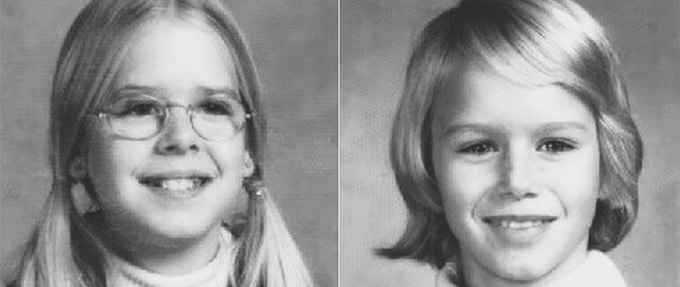
“A sense of security was shattered in the spring of 1975, when two young sisters from Montgomery County went to the mall to have pizza with friends, but never made it home.”
That’s how the Maryland Daily Record summarized the events of March 25, 1975, when Katherine and Sheila Lyon vanished on their way home from the local shopping mall.
Katherine was ten years old. Sheila was twelve. The two were just days away from their next birthdays. It was the second day of their school’s spring vacation, and the two sisters decided to walk from their family home to what was then the Wheaton Plaza shopping center, where they planned to get pizza at a popular local pizza joint.
Neither would ever return — and their bodies have never been found.
A More Innocent Time

 Photo Credit: Wikimedia
According to eyewitness accounts – including their own brother, who saw them eating pizza at the mall around 1 or 2pm – the girls left Wheaton Plaza around 2 or 3 o’clock. They were walking west, toward their home, the last time anyone besides their abductors saw them alive.
When they left, their mother told them to be home by 3 or 4 o’clock. When they weren’t back by the time their mother started preparing dinner, she began to get annoyed, then worried. Before long, that worry turned to fear. “We were really scared,” Mary Lyon told the Toledo Blade, and they called the police.
In the hours and days that followed, the family kept a round-the-clock vigil so that one family member was always near the telephone. They hung missing person posters, conducted neighborhood searches, and announced the disappearance on WMAL, where their father, John Lyon, worked as a disc jockey.
The police, meanwhile, conducted house-to-house searches, scoured the surrounding area using search and rescue dogs and a State Police helicopter, interviewed dozens of witnesses, and followed up hundreds of leads. A reward of $9,000 was offered for the sisters’ safe return – an amount that would increase to $19,000 by April of 1975.
In spite of all this, however, no sign of the girls was ever recovered. By the summer, the family had to contend with the fact that the two girls were likely deceased, and by the early 1980s, the investigation had become a cold case, even though the Montgomery County Police Department continued to receive more than a dozen leads each year.
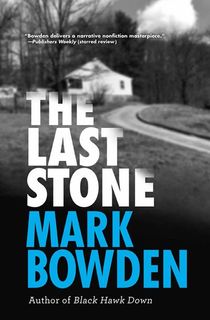
Read the whole story of Katherine and Sheila Lyon in The Last Stone
In 1975, Mark Bowden was a cub reporter in Baltimore who covered the frantic first weeks of the disappearance. More than 40 years later, he wrote what would become its closing chapter in a book titled The Last Stone, which chronicled the “unprecedented” work that took place in 2013, when the case was re-investigated and one of the culprits perhaps finally brought to “some semblance of justice.”
Ironically enough, that culprit was Lloyd Welch, one of the very first people who approached authorities following the disappearance. In 1975, a then 18-year-old Lloyd Welch told a security guard at the shopping center that he had seen someone matching the police description of a probable suspect at the mall on the day of the girls’ disappearance.
While the police initially took Welch’s claims seriously, they ultimately determined that he was likely just trying to claim the proffered reward money after he failed a polygraph test and admitted that he had given false information.
Four decades later, the police were talking with Welch again, but this time he was already behind bars, serving a 29-year sentence at the James T. Vaughn Correctional Center in Delaware, where he had been convicted of molesting a 10-year-old girl.
The Last Stone

What happened to Katherine and Sheila Lyons?
 Photo Credit: Wikimedia
 “I know why you’re here,” Lloyd Welch said when he was approached in October of 2013 by Detective Dave Davis, Sergeant Chris Homrock, and Deputy State’s Attorney Pete Feeney. “You’re here about those two missing kids.”
So began the first of several interviews authorities conducted with Lloyd Welch. By 2013, Welch had attained a considerable criminal record, including charges for assault, molestation, and more. As the authorities interviewed him, he changed his story repeatedly, but ultimately confirmed that he had played at least some role in the disappearance of the two girls. By 2014, when he was declared a person of interest in the case, a picture had begun to emerge.
Someone in Welch’s family — likely Lloyd Welch himself — had abducted the two girls on their way home from the mall, with the intent of raping them. The two girls had then been abused by either Welch, his father, or his uncle, or some combination of the three, before they were killed to cover up their crimes.
The bodies of the two girls were likely burned on property belonging to the Welch family in Taylor’s Mountain, Virginia — a little over a hundred miles from where they had disappeared.
Lloyd Welch charged with murder
In July of 2015, Lloyd Welch was charged with two counts of first-degree murder. He would ultimately plead guilty as part of a plea bargain in which he admitted to abducting the girls but not to their rape or murder. Though investigators suspected other members of Welch’s family of being involved in the crimes, they were not charged either due to lack of sufficient evidence or because they were dead by the time of the investigation.
Despite Welch’s testimony and numerous forensic searches of his family’s property in Virginia, the bodies of the two Lyon girls were never recovered.
When Welch was finally indicted forty years after the disappearance of Sheila and Katherine Lyon, investigators had put more than 16,000 hours into the case just since it was reignited in 2013.
“We just want to say, ‘Thank you,’” John Lyon, by then 77 years old, said after Lloyd Welch was sentenced to two consecutive terms of 48 years each. “It’s been a long time. We’re tired and we just want to go home.”
Featured image via Wikimedia Commons.


