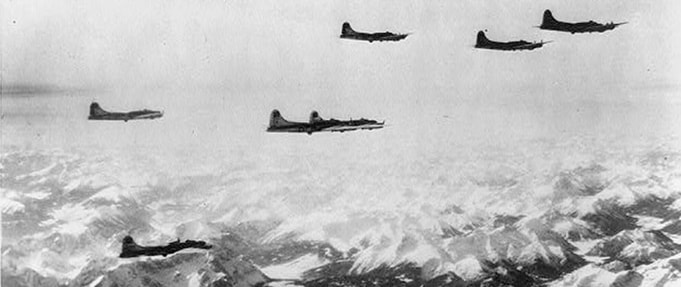
When the first units of the United States Army Air Forces arrived in Britain in 1942, the shift was felt quite quickly, even in areas that had already adjusted to the routines of war. The Eighth Air Force did not build slowly. It expanded at pace, bringing with it aircraft, personnel, and a distinct rhythm of life that had crossed the Atlantic.
Much of that activity settled across East Anglia. The land itself suited the purpose. Open, level, with little to interrupt it. In places that had been ordinary farmland, airfields began to take shape. Concrete replaced fields. Perimeter tracks cut across what had been hedgerows and boundaries for generations.
Villages that had remained relatively quiet through the earlier years of the war were, almost without warning, hosting large numbers of American personnel. They came from small Midwestern towns, from the South, from cities along the eastern seaboard.
Accents varied, as did backgrounds, though they found themselves sharing the same ground soon enough. People noticed it at the time. They were allies, certainly, but there was still the feeling of something slightly unfamiliar about them.
By 1943, and into the following year, the Eighth Air Force was fully embedded in the Allied effort over Europe. The bombing missions went out in daylight, one after another. Losses were expected. The pace did not ease.
It is around this point that the accounts begin to take on a strangely eerie tone.
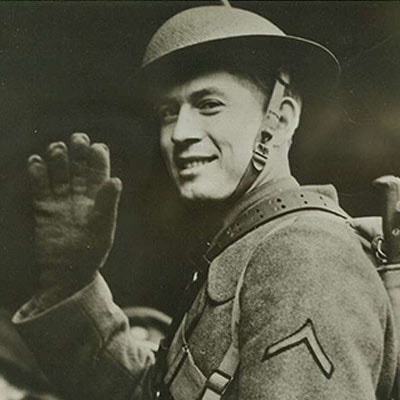

Selected at random from his unit to be the first to disembark, Private Milburn Henke of Hutchinson, Minnesota was reported to be the first American soldier to land on British soil.
Photo Credit: The Allison Collection, MacArthur Museum of Arkansas Military History.Thorpe Abbotts and the 100th Bomb Group
In Norfolk, RAF Thorpe Abbotts became home to the 100th Bomb Group in 1943. They flew B-17 Flying Fortresses on missions over Germany and occupied Europe. Over time, the scale of their losses led to the name “Bloody Hundredth,” one that stayed with them long after.
Even during the war, there were reports of a figure seen around the base. He became known simply as “Eddie.” Witnesses described a man in flying gear. He would be seen briefly, standing or moving through a space, and then no longer there.
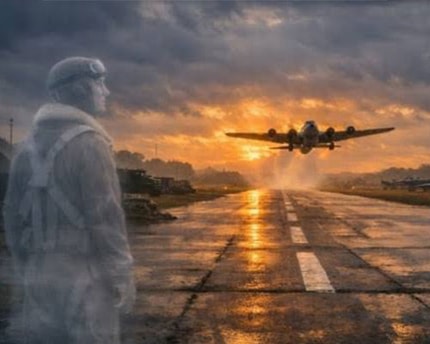
“Eddie the Ghost.”
Photo Credit: Facebook: Hadyn BrownThe timing is part of what makes it notable. These were not stories gathered years later, shaped by memory or retelling. They were spoken about while the base was still active, among men already dealing with the strain of operations.
Parts of the site have since been preserved as a museum dedicated to the 100th Bomb Group. Visitors walk across the same ground, though the urgency that once defined it has long faded. The stories remain attached to the place, but they tend to sit in the background rather than draw attention to themselves.
RAF Grove and the Smaller Moments
RAF Grove in Oxfordshire formed part of the wider American presence in Britain, used primarily for transport and support roles. It did not carry the same operational weight as the bomber bases of East Anglia, but it remained connected to the same network.
The accounts linked to Grove are limited, but consistent in tone. A voice heard in an otherwise empty hangar. The brief appearance of a man in American uniform, seen clearly for a moment, then gone before it can be properly understood.
More often, they persist as fragments, passed on in conversation without much effort to turn them into a single, defined account.

Ariel View of RAF Grove- April 21, 1943.
Photo Credit: Wikimedia CommonsLarge parts of the airfield have returned to agricultural use. Without knowing what once stood there, it can be easy to pass by without noticing anything unusual. A section of worn concrete, a slight break in a hedgerow, the outline of something that once had a clear function.
Bassingbourn and the Continuation of Routine
In Cambridgeshire, RAF Bassingbourn served as a base for the 91st Bomb Group, another Eighth Air Force unit flying B-17s. Like others in the region, it was part of the daily rhythm of operations, sending aircraft out whenever conditions allowed.
The crews stationed there came from across the United States, often meeting for the first time during training before finding themselves flying together over occupied Europe. By the time they reached England, routines had already begun to form. Briefings, take-offs, returns. The structure held, even when the outcomes did not.
After the war, the site passed through different uses, though parts of it were left to change more gradually. Later accounts tend to describe something less defined. Not a single event, but more of an ongoing presence.
Figures are sometimes reported at a distance, moving with intent, only to disappear when someone gets closer. There is no sense of interruption in these reports. If anything, they suggest continuation.
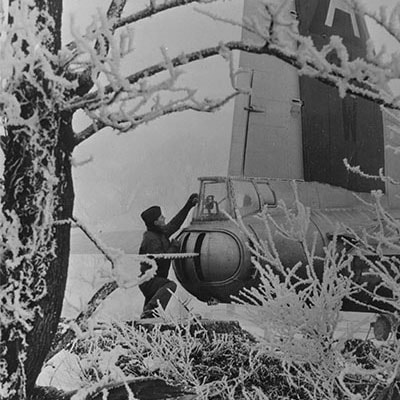
Handwritten caption on photo: "Bassingbourn. 48431, OR-W. 91BG. US 8th AF Gunner prepares for take-off - a tail gunner of the 91st Bombardment Group, 8th USAF clears the plexi-glass window in front of his gun sights before taking off from a snow shrouded base ‘in England'.
Photo Credit: Imperial War Museums: American Archive of BassingbournAcross East Anglia
Seen individually, each of these accounts can be set aside without too much difficulty. East Anglia, however, held a dense concentration of American airfields during the war. Names such as Molesworth, Kimbolton, Horham, and many others formed a network that supported the wider campaign.
Aircraft left these runways on a near-daily basis, often in large formations heading out over the North Sea. Losses were frequent enough that they became part of the expected pattern, even if never fully accepted.
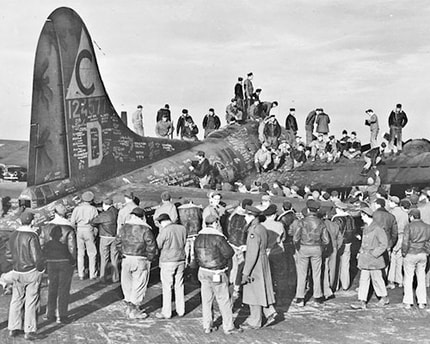
The 303rd Bomb Group nicknamed “Hell's Angels” stationed at Molesworth, England.
Photo Credit: 303rdbg.comToday, many of these sites sit quietly within the surrounding landscape once again. Farming has returned. Roads have shifted. Buildings have been removed or left to fade where they stand. In some places, only fragments remain. In others, there is almost nothing visible at all.
What becomes apparent is that these reports are not limited to just a few well-known locations. Similar accounts appear across the region, linked to different airfields yet following broadly comparable patterns.
There is a resemblance between them that stands out. Not identical accounts, but close enough to suggest a shared pattern. Taken together, they point to something that extends beyond a small number of isolated stories.
What Remains
By the end of the war, the Eighth Air Force had sustained significant losses. Thousands of American airmen failed to return from their missions. Many were buried across Europe, some later repatriated, while others remained where they had fallen.
For the communities that had hosted them, their departure brought a return to quieter routines, though not entirely as before. Airfields that had once been central to daily life slipped back to the margins.
Over time, the physical traces have continued to fade. Concrete breaks down. Structures disappear. The landscape closes over what was once imposed upon it.
They are not widely discussed, yet they appear often enough to draw the attention of those who look into such things. They do not form a single narrative, nor do they offer clear conclusions. Memory explains part of it, though perhaps not all.
In those places, the impression is less of something coming back, and more of something that never entirely moved on.
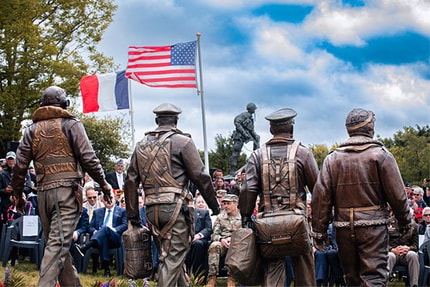
WWII Mighty Eighth Airmen memorialized in European sculpture.
Photo Credit: Air Force Global Strike Command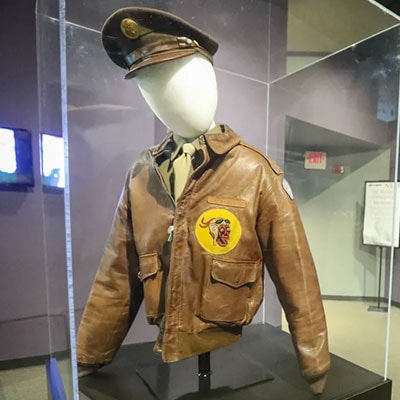
A bomber jacket and hat are displayed a the National Museum of the Mighty Eighth Air Force.
Photo Credit: Savannah Morning NewsFurther Reading
Freeman, Roger A. The Mighty Eighth
Bowman, Martin W. Airfields of the Eighth Then and Now
American Air Museum in Britain, Imperial War Museum (online archive)
100th Bomb Group Memorial Museum, Thorpe Abbotts
Ghost Airfields of Britain (various authors)
Feature Image: Library of Congress


