While archaeology and scholarship have unearthed countless facts about the ancient world, there are still more questions than answers, and many mysteries of ages past will probably never be fully explained.
Here are seven unsolved mysteries of the ancient world that still divide, trouble, and flummox scientists and historians to this day.
The Ark of the Covenant
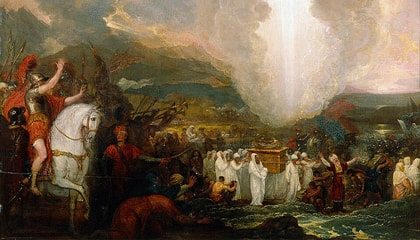
 Photo Credit: Wikimedia Commons
Anyone who has seen the first Indiana Jones movie will be familiar with the Ark of the Covenant, an ornamented wooden chest said to hold the stone tablets on which the Ten Commandments were carved.
According to that movie, the Ark is currently stored in a colossal government warehouse. But where is it really? Prior to around 587 BCE, the Ark is said to have been kept in the massive First Temple constructed by King Solomon.
That year, however, Babylonian King Nebuchadnezzar II sacked Jerusalem, including the aforementioned temple. Did the Babylonians take the ark with them, or was it hidden away for safety before they could get their hands on it?
Archaeologists and theologians all disagree about where the ark might be located—or, in some cases, if it even existed at all.
Nazca Lines
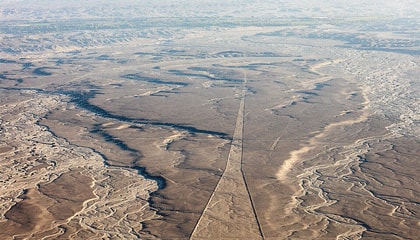 Photo Credit: Wikimedia Commons
In the desert of southern Peru, massive geoglyphs continue to puzzle historians and archaeologists. These designs were painstakingly carved into the desert floor between 500 BCE and 500 CE, creating complex shapes visible only from the air.
What was the purpose of these massive designs, some of them as much as 400 yards in length? Were they linked to religious practices? Were they representations of celestial bodies and constellations?
It has even been suggested that the Nazca lines may have been used for irrigation or in the creation of massive textiles. While the lines themselves are now a NESCO World Heritage Site, helping to preserve them so that future generations can puzzle over them, their purpose remains an intriguing mystery.
The Plain of Jars
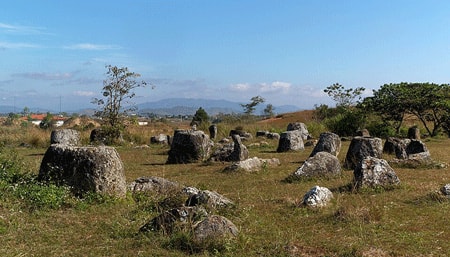 Photo Credit: Wikimedia Commons
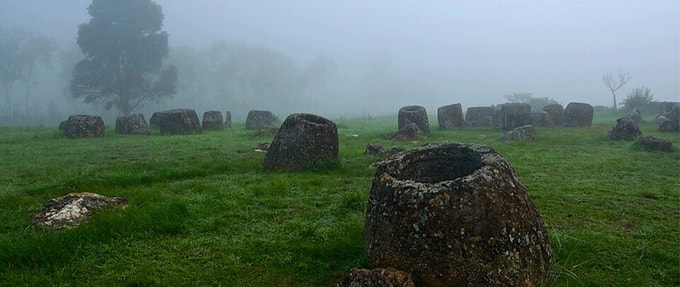
Monolithic stone jars dot the landscape of the Xieng Khouang Plateau in Laos. Standing between three and nine feet in height, the jars are all carved from stone, and there are over two thousand of them!
Archaeological evidence suggests that the jars were placed as much as three thousand years ago, possibly as early as 1240 BCE. They are scattered across more than 90 sites. Some feature only a single stone jar, while others may hold as many as 400.
What were the jars used for? Many scholars assume they were burial sites, but numerous questions remain, including the purpose of more than 200 stone discs found nearby.
Initially thought to be lids for the jars, their size and shape are wrong for that function, so some have concluded that they are instead burial markers for these unusual tombs.
The Tomb of Alexander the Great
 Photo Credit: Wikimedia Commons
Before 323 BCE, Alexander the Great swept across much of the continent of Asia. In the movie Die Hard, terrorist villain Hans Gruber likely misquotes Plutarch (or maybe a Twilight Zone episode) when he says, “And when Alexander saw the breadth of his domain, he wept, for there were no more worlds to conquer.”
At just 32 years old, Alexander the Great died in Babylon. According to ancient accounts, his body was first buried in Memphis before being reinterred in Alexandria. Notables such as Julius Caesar and Cleopatra were said to have visited the tomb.
There’s just one question: Where was it? Unfortunately, we don’t know, and more than one hundred official expeditions have thus far failed to identify the burial place of the legendary conqueror.
The Antikythera Mechanism
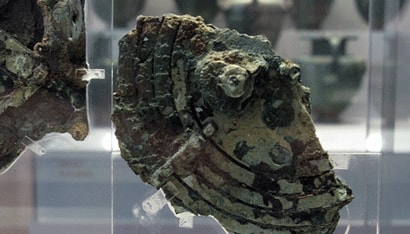 Photo Credit: Wikimedia Commons
Sometime between 70 and 60 BCE, a Greek ship sank off the coast of the island of Antikythera. It wouldn’t be salvaged for almost two thousand years, when sponge divers rediscovered the wreck and began retrieving artifacts. Among these was an object unlike anything seen before—or since.
Originally composed of around 37 meshing bronze gears, the device known as the Antikythera mechanism is believed to have been the earliest known example of an analog computer, capable of predicting astronomical events and dates decades in advance.
While the device's function was the first mystery, others remained even after that one was solved; most notably, how was the device made?
“No earlier geared mechanism of any sort has ever been found,” writes Jo Marchant in Nature. “Nothing close to its technological sophistication appears again for well over a millennium”—until the fourteenth century, to be exact, when clocks began to appear in medieval Europe.
The Lost Army of Cambyses
 Photo Credit: Wikimedia Commons
According to Herodotus, Persian king Cambyses II sent an army of some 50,000 soldiers into Egypt’s Western Desert in 525 BCE. Their mission was to confront the Oracle of Amun at the Siwa Oasis—but they never arrived.
“After that,” Herodotus writes, “no man can say anything of them, for they neither reached the Ammonians nor returned back.” He goes on to write that a “great and violent south wind arose, which buried them in the masses of sand which it bore; and so they disappeared from sight.”
What ultimately became of the army, and why have they never been found? Well, some say they have, including two Italian filmmakers, Angelo and Alfredo Castiglioni, who claimed to have unearthed the lost army in 2009.
The only problem? According to the Egyptian Supreme Council of Antiquities, “The Castiglioni brothers have not been granted permission by the SCA to excavate in Egypt, so anything they claim to find is not to be believed.” So, for now at least, the mystery remains unsolved.
The Hypogeum of Hal Saflieni
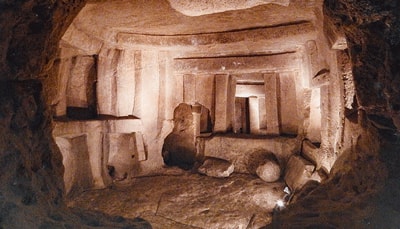 Photo Credit: Wikimedia Commons
In 1902, workers in Malta accidentally discovered an underground burial chamber that had been hidden for thousands of years.
The structure, sometimes simply called the Hypogeum—literally “underground” in Greek—dates back at least to 2,500 BCE and consists of three levels hewn from the surrounding limestone. Within these chambers were interred as many as 7,000 bodies.
Today, the Hypogeum is a museum and protected historical site, but many mysteries remain about its origins and uses, including a unique chamber known as the Oracle Room, which creates resonances that allow sounds made there to be heard throughout the Hypogeum.
Featured image: Wikimedia Commons


