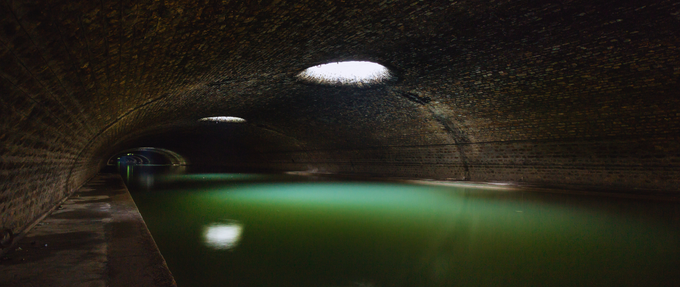
It was February 9, 1935, and several boys were clearing snow from East 123rd Street in Harlem. Rather than piling it along the sidewalk, they were shoveling it into an open manhole. Nobody could have imagined what they were about to discover in the water below.
Sixteen-year-old Salvatore Condulucci was the first to notice something moving. Looking down into the opening, he called to his friends. According to the following day's newspaper report, his words were: “Honest, it's an alligator!”
The boys found some clothesline and managed to make a noose. Lowering it into the sewer, they eventually caught the animal around the neck and dragged it up onto the street. The alligator was said to measure between seven and a half and eight feet long and weigh around 125 pounds.
Although the freezing water had left it weak, it still managed to snap at one of the boys. They killed it with their snow shovels.
Its body was taken to a nearby repair shop, where curious residents gathered to see the unexpected visitor. Later that evening, a sanitation truck collected the carcass for disposal. The following morning, The New York Times carried the headline “Alligator Found in Uptown Sewer.”
It was certainly a strange incident, but it was not the last time New Yorkers would hear about alligators beneath their streets. Over the years, the story grew considerably, eventually becoming one of America's best-known urban legends.
A Most Unusual Pet
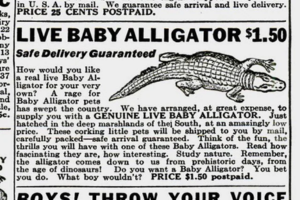

Newspaper clipping from the 1950/60s
Photo Credit: RedditNobody could explain how the Harlem alligator had reached the sewer. One suggestion was that it had fallen from a ship arriving from Florida, swum through the Harlem River and entered an underground drain seeking shelter. There was, however, another possibility.
In the 1930s, keeping an alligator as a pet was not quite as unusual as it might seem today. Live baby alligators appeared in mail-order advertisements, while tourists visiting Florida could buy them as souvenirs and take them home. A 1934 Johnson Smith advertisement offered a live baby alligator for just $1.50.
Small enough to fit inside a household aquarium, these reptiles must have seemed wonderfully exotic pets. Unfortunately, they had a habit of growing. An animal that once fitted comfortably into a glass tank could eventually
become difficult to feed, impossible to handle and thoroughly unwelcome in the family bathroom.
According to the developing legend, frustrated owners solved the problem by flushing their alligators down the toilet. Once underground, the creatures supposedly survived on rats and garbage, growing to enormous proportions. There was an obvious flaw in the story.
Anything larger than a very young alligator would struggle to pass through household plumbing. Abandonment through a storm drain or manhole was much more plausible. Still, the image of unwanted alligators disappearing down New York's toilets was irresistible.
The Man Who Found an Underground Colony
The Harlem discovery gave the legend newspaper evidence. A sewer worker named Teddy May supplied something rather more extraordinary.
May was a colorful character associated with New York's underground drainage system. Often described as the city's Superintendent of Sewers, later researchers have questioned his exact position. His remarkable claims appeared in Robert Daley's 1959 book The World Beneath the City.
According to May, sewer inspectors began reporting alligator sightings around 1935. Convinced that his men had been drinking, he decided to investigate for himself. What he claimed to discover was astonishing. By flashlight, May supposedly saw small alligators swimming through the city's underground pipes.
Some were said to measure around two feet long. An extermination campaign followed. Inspectors allegedly poisoned some animals, shot others and drove the remainder into larger sewer lines. Within months, the underground population had supposedly been destroyed.
It was a wonderful story, but there was a problem. No convincing official records, photographs or surviving specimens have emerged to substantiate the supposed campaign. May was known as a storyteller, and Daley's account depended heavily upon his recollections.
That does not necessarily mean every detail was invented. Sewer workers might well have encountered individual abandoned reptiles. But an organized campaign against an established colony was another matter entirely. Nevertheless, the legend had acquired something it previously lacked: an entire hidden population.
The Rise of the Albino Alligator
As the years passed, the alligators supposedly living beneath New York became increasingly difficult to recognize as ordinary reptiles. Some were said to have grown to enormous sizes, feeding on the rats that inhabited the tunnels.
Others were described as completely white, the result, according to the stories, of spending their entire lives underground. Of course, living in darkness does not turn an alligator white. Albinism is inherited, although that small biological detail did little to discourage the storytellers.
By 1963, the legend was familiar enough for Thomas Pynchon to include an alligator patrol in his novel V. The story was still circulating during the 1970s, and in 1980 it reached cinema audiences in Alligator, directed by Lewis Teague and written by John Sayles.
The film was set in Chicago rather than New York, but the idea was much the same: an unwanted pet flushed into the sewers, only to reappear years later as a monster.
It was the sort of story that needed very little introduction. People had been hearing variations of it for decades.
Could They Really Survive?
For a short time, an abandoned alligator might survive in New York's drainage system. There could be water, occasional food and places offering some protection from the weather. But surviving a few weeks or months is very different from
establishing a breeding population.
The greatest difficulty would have been the cold. Alligators need warmth from their surroundings to maintain their body temperature, something that would be difficult to find beneath New York during the winter months.The 1935 Harlem alligator itself was reportedly weakened by the freezing conditions.
Rather than a powerful underground predator, it appears to have been a stranded animal struggling to survive. The idea of generations of enormous albino alligators flourishing beneath Manhattan remains unsupported by credible evidence. Yet genuine alligator discoveries in New York have continued.
The Alligator in Prospect Park
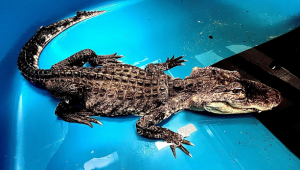
Alligator at the Bronx Zoo before rehabilitation.
In February 2023, nearly ninety years after the Harlem incident, another alligator appeared in New York. This time the location was Prospect Park Lake in Brooklyn. The nearly five-foot female, later named Godzilla, was severely underweight and suffering from exposure to the cold.
She was transferred to the Bronx Zoo, where veterinarians discovered something unexpected. Inside her stomach was a four-inch bathtub stopper.
Despite intensive treatment, Godzilla died in April. Zoo officials believed she had been illegally kept as a pet before being abandoned. Her condition revealed the suffering behind what might otherwise have seemed another amusing alligator story. There was something familiar about the discovery.
Almost ninety years had passed since the Harlem incident, yet here was another alligator struggling to survive a New York winter. Whatever the circumstances of its arrival, the animal had clearly suffered.
The Legend That Refused to Die
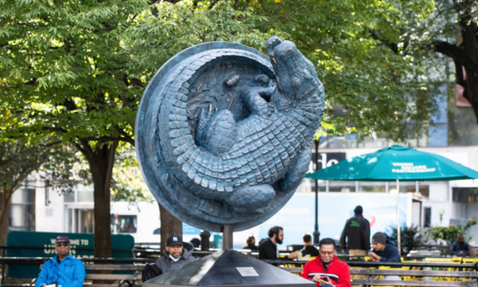
Sewer Alligator Sculpture in Union Square
Photo Credit: Secret NYCNew York has since embraced its unlikely underground resident. At the 14th Street and Eighth Avenue subway station, Tom Otterness's Life Underground sculptures include a bronze alligator emerging from beneath a manhole cover.
Another bronze alligator appeared in Union Square in 2023. Alexander Klingspor's N.Y.C. Legend depicts the reptile curled around a familiar New York manhole.
What began as a strange newspaper report had become part of the city's identity. So what should we make of New York's sewer alligators?
The 1935 Harlem discovery was reported in the newspapers, and there have been other genuine cases of alligators turning up in the city's parks and waterways. What remains missing is any convincing evidence that a breeding colony ever existed beneath the streets.
The legend grew from something genuine: the trade in exotic pets, irresponsible owners and occasional encounters with animals that had no business being there. New York provided the dark tunnels. Generations of storytellers supplied the monsters.
Perhaps that is why the tale has survived for so long. The best urban legends are not complete fantasies. They begin with something that really could have happened. In this case, something did.
Further Reading
• The New York Times, "Alligator Found in Uptown Sewer," February 10, 1935.
• Robert Daley, The World Beneath the City (J. B. Lippincott, 1959).
• Robert E. Bartholomew, "Alligators in the Sewers!", Skeptic, Vol. 21, No.1.
• The New York Times, “The Book Behind the Sewer-Alligator Legend,” November 23, 2009.
• Wildlife Conservation Society / Bronx Zoo, "Update on American Alligator Rescued from Prospect Park Lake," February 22, 2023, and “Bronx Zoo Issues Update on Alligator Found in Prospect Park Lake,” April 21, 2023.


